 Share:


Automotive painting may seem a specialized trade, but at the 48th WorldSkills Competition in Shanghai, it offered a glimpse of broader changes in vocational skills, from greener materials and shifting technical jobs to artificial intelligence and rising demand for skilled workers.
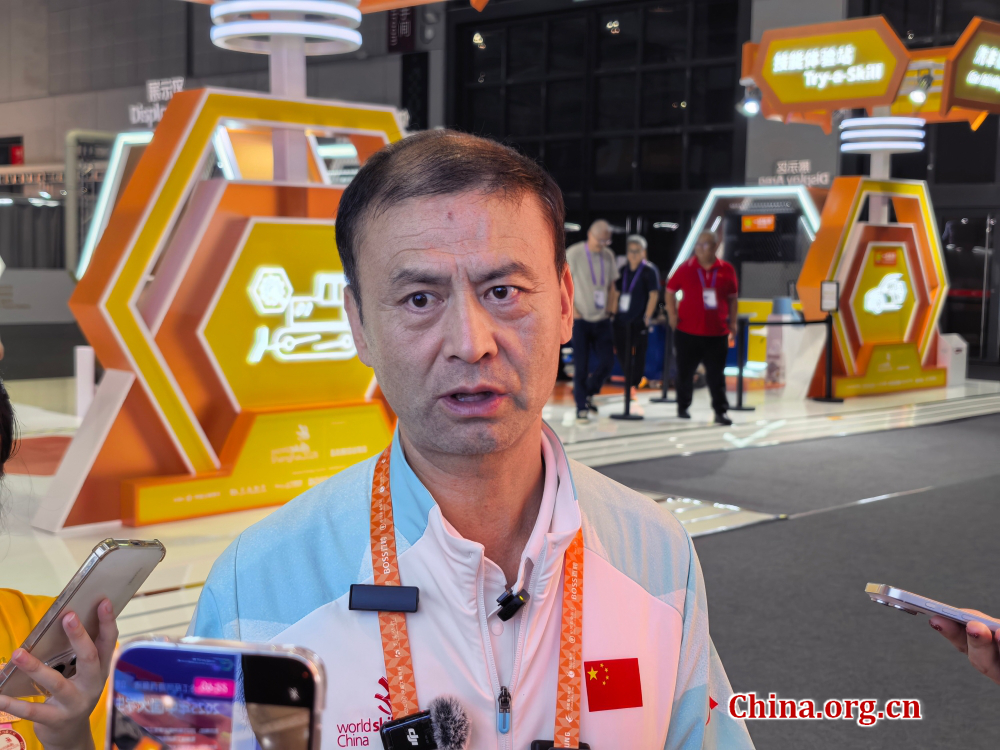
Zhang Xiaopeng, head of the Chinese Technical Guidance Expert Group for Automobile Painting at the 48th WorldSkills Competition, speaks during an interview at the competition venue in Shanghai, Sept. 26, 2026. [Photo by Mi Xingang/China.org.cn]
Zhang Xiaopeng, a senior technician at the Hangzhou Technician Institute and head of the Chinese Technical Guidance Expert Group for Automobile Painting at the 48th WorldSkills Competition, was closely involved in preparing the Chinese contestant for the event in Shanghai. In an interview at the competition venue on Sept. 26, he said the contestant performed steadily and completed all the required tasks.
With the top competitors closely matched in skill level, the ability to quickly assess and adapt to unfamiliar tasks becomes especially important, he said.
Because the test tasks are not disclosed in advance, competitors must make quick judgments once the competition begins. This year, for example, the tasks included repairing combined components such as a door and a fender, adding complexity to a test that had traditionally involved individual components, he added.
"The technical standards have not changed dramatically, but the tasks change from one competition to another," Zhang said.
At the competition in Shanghai, contestants worked with water-based paints and other environmentally friendly products supplied by international sponsors. Zhang said visitors to the venue might have been surprised by how little it resembled the conventional image of an auto-painting workshop.
"There was almost no smell, dust or visible pollution," he said.
The competition also closely mirrored real-world repair work, using automotive components and products common across the industry. Zhang said this link between WorldSkills and industry helps bring new technologies and processes into companies and vocational schools.
Yet the skills demonstrated at WorldSkills go beyond what most workers are required to do in a typical repair shop.
In industry, work is usually divided into specialized roles, with each worker focusing on one part of the process and performing it well, Zhang said. At WorldSkills, however, competitors are expected to be all-rounders, completing the entire process, from repair and color matching to painting and polishing, within 16 hours while maintaining a high level of quality.
These demanding standards also feed back into vocational education. Zhang said his teaching follows standardized procedures from the outset, training students to high standards and identifying their weaknesses so they can improve through practice.
"The standards are essentially the same," he said. "The difference is how well they are carried out."
Artificial intelligence and robotics are entering the automotive repair industry, raising questions about whether machines could eventually replace skilled workers. Robots are already being developed for painting, while some companies are working on robotic sanding systems.
Zhang, however, sees clear limits to automation for now. Sanding, polishing and color matching require decisions based on the specific damage, shape and color of each vehicle. With countless combinations of models, colors and accident conditions, such work remains highly individualized, he said.
He did not rule out further technological advances but said there is currently no clear timeline for machines to take over these tasks.
As new energy vehicles grow more sophisticated, repair and finishing requirements are becoming more demanding. Companies need workers who can deliver standardized, high-quality repairs, Zhang said, but finding such talent remains difficult.
He said this is where WorldSkills can make a difference. With the competition held in Shanghai, vocational schools from across China have been able to observe the event firsthand rather than traveling overseas.
Seeing competitors from around the world, understanding international standards and witnessing how technology is changing the trade could help schools raise the quality of their teaching, he said. The event could also help change perceptions of the profession and encourage more young people to pursue skills training, he added.
"It's a traditional profession," Zhang said. "But precisely because fewer young people choose it, skilled workers are in demand. The better you become, the more opportunities you have."


 京公网安备 11010802027341号