Tears behind the laughs
 0 Comments


 |
|
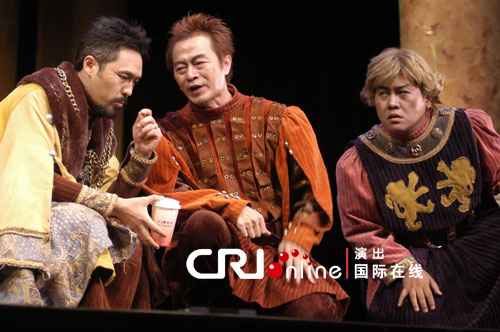
Taiwan director Hugh Lee Kuo-shiu's Shamlet is on stage at BTV Theater from Thursday to Saturday during the on-going Beijing Comedy Festival. |
Taiwan's Ping-Fong Acting Troupe returns to Beijing with its classic situation comedy Shamlet, for the third time, to participate in the on-going Beijing Comedy Festival.
Yes, it's Shamlet not Hamlet. It's not Shakespeare's well-known tragedy but director Hugh Lee Kuo-shiu's "salute" to the bard. The production tells the story of an amateur theater troupe which goes on a tour with the play Hamlet. After they debut to a very lukewarm reception, they vow to strive harder, but are plagued by problems among the cast. They rehearse the most well-known parts of Hamlet again and again but personal vendettas turn the play into a chaotic mess.
"I respect Shakespeare. His dramas are a powerful reflection on life. I believe every director wants to do a Shakespearean play but at the same time, I always wonder if there is any connection between the tragedy of Hamlet and the lives of ordinary people today?" says the 54-year-old director/playwright.
Lee has been interested in making plays that reflect contemporary life ever since he founded the Ping-Fong Acting Troupe in 1986. But after a few years of struggle in Taiwan's theater scene, he realized it was difficult for a young director like him to rise to fame by doing original plays. He decided to "make use of Shakespeare."
"Shakespeare is the greatest playwright in the world, but there's one aspect in which I'm superior to him. I am alive. I can re-create a play based on his classics. Hamlet is my favorite play by the bard, so I chose it," says Lee.
In 1992, Shamlet, Lee's 11th play, premiered in Taipei and was a huge success. As one of the most popular repertoires of the company, it has been seen by more than 130,000 people across Taiwan over the past 17 years, and was revived in 1995, 2000 and 2006.
In 2007 and 2008, the troupe staged seven shows in Beijing, all of which were sold out.
At its Beijing debut at the PLA Theater on May 11, 2007, the audience gave it a standing ovation that lasted a good eight minutes.
In Shamlet, director Lee adopts the form of a play-within-a-play. He has done a series of productions using the same format.
In another of Lee's well-received works, Apocalypse of Peking Opera, he creates an old Peking Opera company founded in the 1940s that moved from Shandong province to Taiwan in 1949 and struggles to survive today.
Lee wrote and directed the play for his father who specialized in making the shoes for Peking Opera performers in Shandong province before the family moved to Taiwan in 1949. He has witnessed the up and downs in Peking Opera in the last century.
Many scenes of Apocalypse of Peking Opera are drawn from the director's own life. For example, one day the 16-year-old Lee asked his father, "You've spent all your life making shoes for Peking Opera performers, but never made big money. Was it worth it?"
And his father replied: "If one person could do well in one thing in life, that's enough."
Lee quotes this sentence in Apocalypse of Peking Opera and has also made it his personal motto.
Born in 1955 in Taipei, Lee fell in love with theater while studying at Taipei's Shih Hsin University, where he tried his hand at writing scripts and also performed in the students' drama troupe. After graduation, he joined some troupes such as Stan Lai's Performance Workshop, became active on TV and soon rose to fame as a well-known comedian in Taiwan.
The name of his troupe, Ping-Fong (Pingfeng), means screen, and refers to the most common method of blocking off an outsider's view in traditional Chinese houses. Under his direction, the Ping-Fong Acting Troupe has produced nearly 40 works earning him the moniker, "Taiwan's Moliere".
Despite his comedies, the acclaimed director/playwright invariably leaves audiences with some weighty questions.
One reason he likes to set his stories in an amateur company is because he wants to send the message that troupes are struggling to survive and performing artists lead a tough life in today's Taiwan.
"Good my lord, will you see the players well bestowed? Do you hear, let them be well used; for they are the abstract and brief chronicles of the time," he says, quoting the lines from Hamlet. These same lines occur frequently in Shamlet, underscoring Lee's concerns for the state of theater in Taiwan.
"I had two dreams when I decided to do drama. The first was to have a company of some 200 performers and staff and another, to have a 1,500-seat theater. But now I think I may never be able to reach either of them," says the comedian with a sigh.
His company now has just 14 full-time staff and all the performers sign contracts on a play-by-play basis. As for theaters, he says Taipei has only two theaters fit to stage dramas. Too many troupes are competing to book the venues.
"But what makes me somewhat happy is that I also set three goals when I founded the troupe and so far, we are on the right track. The first was to be able to make a living. We make enough money to have food and clothing. Second, the company has grown steadily and has regular shows and tours. Last but not least, I and other senior artists have trained many young talents to pass on the art," says Lee.


Comments