Fang vs. Han: War of words set for showdown
 0 Comment(s)
 Print
Print E-mail China Daily, February 1, 2012


|
|
|
Fang Zhouzi (left), known for exposing academic fraud, has questioned the work of Han Han, one of the best-selling writers in China. Han is suing over Fang's stated suspicion that Han's works were ghostwritten. [China.org.cn] |
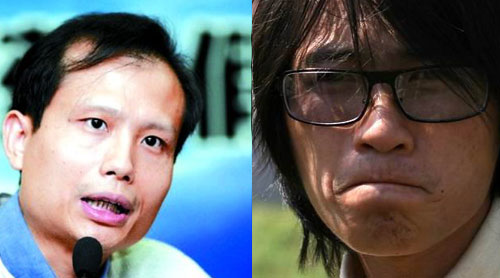
The duel of words has escalated into a battle in court between a bestselling author and a wildly popular blooger known for exposing academic frauds.
Han Han, the 29-year-old novelist, championship amateur race-car driver and one of Time Magazine's "100 most influential people" in 2010, submitted a bill of complaint to the court on Tuesday, his publisher said. Han is suing blogger Fang Zhouzi for libel because Fang claimed Han's works may be ghostwritten.
The lawsuit fuels an already heated dispute that, as of Tuesday afternoon, had sparked more than 14.8 million micro blogs on Weibo, China's largest micro-blogging platform, since it started on Jan 15. Han's supporters outnumbered Fang's about 4-to-1. Numerous bloggers, intellectuals and celebrities also voiced their opinion.
In an interview, Han Han said he thinks it is unlikely he would lose the case in court. "If you read the micro blogs posted by Fang Zhouzi concerning his accusation against me, you will find clear evidence of actual malice," he said on Monday.
Fang told China Daily he had not intended to disparage Han. "Why should I bother to defame him? I don't even know him. There is no grudge between us."
The clash began when a popular blogger, Mai Tian, claimed Han's works might have been written by his publisher, Lu Jinbo, and said there is a team of ghostwriters behind Han.
Han responded the next day, offering 20 million yuan (nearly $3.2 million) to anyone who could prove his works were ghostwritten.
When Mai apologized to Han on Jan 18, admitting he didn't have sufficient evidence, Fang joined the fray, saying he noticed Han had deleted all his articles from December 2006 to September 2007 from his blog.
"Posting a reward to look for evidence, while at the same time destroying the proof, makes people feel his claims of innocence lack sincerity," Fang said on his micro blog.
Fang also questioned Han's ability to write such mature works at a young age and to write well enough to win a national composition writing contest in 1999. Fang also alleged that Han's father, writer Han Renjun, is the most likely suspect as young Han's ghostwriter.
Han Han responded by saying the articles were deleted in 2008 at the request of his publishing house and to protect his copyright interest. He also said it was impossible for him and his father to have the same writing style.
Han Renjun also posted online his own works that were published around the same time as Han's first novel, Triple Door, so readers could compare the styles. He also said he did not know any judges to manipulate the writing contest won by his son.
 |
Triple Door was published in May 2000 and is said to have sold more than 2 million copies. Han Han, who failed his college entrance exam, also has written other novels and essays that were published and has won numerous fans among the younger generation.
Fighting words
About Fang's accusation, Han said: "Fang said I must have falsely claimed some stories were mine while they were actually written by someone else, but he can't prove it.
"He also pointed fingers at my friends and some media organizations who criticized him for being unfair, saying that he will fix them one by one. Obviously, he has shown actual malice."
Fang replied: "My accusation is based on my analysis of his early works and some contradictory explanations about these works made by him and his father. This is justified freedom of speech and freedom of academic discussion.
"You can disagree with my conclusion and analysis, but you can't say I intended to make a false charge against him."
Fang's doubts
Fang said he was not the least interested in the dispute when Mai Tian accused Han of having others write on his behalf, but was later dragged into the fight.
"I had never read Han Han's works before. In my opinion, he's just another star in the entertainment industry. I didn't have the patience to read Mai Tian's articles either," Fang said, "until Han swore about his credibility, attacked Mai in his blog, and offered 20 million yuan to whoever can prove Mai's accusation is correct. Only an exasperated person in desperation would act this way."
Looking through Mai's articles, Fang found that part of Mai's reasoning was indeed reasonable.
For example, Fang said, Han claimed that he wrote and published a dozen essays and pieces of fiction in one month when he was still a junior school student. Before that, he had not written anything, nor did he write afterward until he entered the essay contest when he was in senior high school.
 |
Such descriptions sounded suspicious to Fang, who questioned Han's ability to write so many high-quality articles, above average for a writer at his age, in such a short time without showing any earlier sign of his talent. He said it is more likely that Han had someone else write for him and that he copied their stories in his own handwriting. Fang also said he thinks the life experience and social background shown in Han's early stories did not match his age.
Han on fiction
Applying so-called "academic analysis" to literary works is ridiculous, according to Han, because literature is not science.
"If a writer wrote in his story it is a sunny day while it actually rains, does that mean he has made a forgery?"
In one of his analytical articles, Fang Zhouzi questioned why Han wrote that he slept in the upper berth in his dormitory when he was a student, while in another story he wrote he slept in the lower berth.
"It doesn't matter which berth I slept in. This is a fiction," Han said. "I can sleep anywhere in my fictions and essays. If a person raises doubts in this way, there will be no fiction at all."
From his point view, Fang's criticism against him has crossed over the line of academic analysis.
"He concluded that I had someone else write on my behalf. For a writer, such an accusation is the most serious of all kinds. He is questioning my integrity and moral quality," Han said.
One of the doubts Fang raised against Han is why he and his father had different explanations for the title of his first novel, which was published nearly 12 years ago. Han said it is understandable that their memories faded in that time.
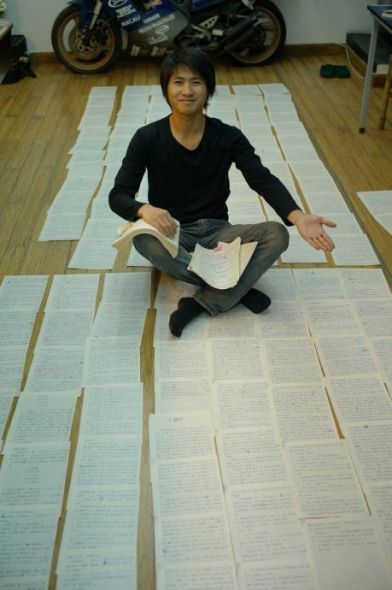
Beyond the arguments, Han said he has kept about 1,000 pages of manuscripts for two of his early works, which he considers proof of his innocence. He said he began to write on a computer starting with his third novel.
"I have manuscripts, witnesses, notebooks and letters I wrote to home. A typical writer would have none of these, for we all write in front of a computer nowadays," Han said. "If people support Fang Zhouzi, whoever makes a living by writing is likely to have rough luck once they pissed him off."
Credibility
Because Fang Zhouzi still has credibility among certain people, Han Han said, he believes his reputation and interests have been damaged, although it is hard to put a price on it.
Han's publisher Lu, who also represents well-known writers including Wang Shuo and Anne Baby, told China Daily on Tuesday that he thinks Fang's actions and series of blog articles have hurt Han's reputation.
|
|
|
Han Han and his manuscripts. [File photo] |
"It's OK that others say a writer writes badly," Lu said. "But it gets serious and becomes a harm when someone claims the writer had others write for him, with no hard evidence and illogical proof."
Lu said they expected to learn on Thursday whether the court would accept Han's lawsuit.
Han Han may find it difficult to win a libel suit against Fang, according to Yao Xinshi, a lawyer at Beijing Tianyuan Law Firm.
He defined libel as the communication of a statement that makes a claim, expressly stated or implied to be factual, that may give an individual, business or product a negative image.
"If Fang is just making a conclusion based on facts, including Han's books or interviews, this is hard to be defined as a libel suit," Yao said.
If the case is not accepted for trial under criminal law, it could be addressed in a civil suit as infringement of reputation rights.
Yao said that every citizen has the right to protect his or her credibility, reputation and privacy. If Han's books are proved to have been his own work, Fang's indictment could be considered an infringement of Han's reputation as a writer.
'Like a game'
Publisher Lu has his own view of why the Han-Fang fight has involved so many actively over more than two weeks.
"It's like a fun soccer game," he said. "When the two sides are balanced in power, the audience feels the most excitement.
"Both Han and Fang have a large number of fans who love them, and a large number of people who dislike them," Lu said.
"And it's not breakthrough events that have clear lines between the black and the white."


Go to Forum >>0 Comment(s)