Decoding Peking Opera
- By Wu Jin
 0 Comment(s)
 Print
Print E-mail China.org.cn, February 23, 2012


Peking Opera spectators bewildered by obscure dialogue squeezed from high-pitched squeals need no longer fear further exploring the genre. A hybrid rendition of traditional opera "The Three Kingdoms", including storytelling, is set to hit stages in Beijing this week.
The three-day run of "The Three Kingdoms," opening Feb. 24 at Beijing’s Chang’an Grand Theater, will benefit from an A-list lineup, including influential Peking Opera star Yu Kuizhi and veteran storyteller Lian Liru.
"The Three Kingdoms," one of the China's most famous epics, has inspired numerous artists and even a chic board game called "Three Kingdom Kill".
|
|
|
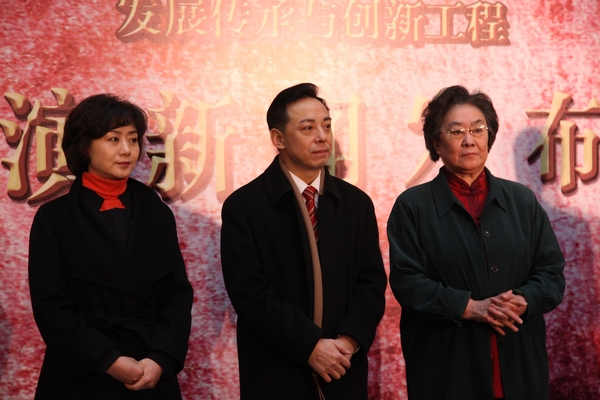
Peking Opera actress Li Shengsu (R), actor Yu Kuizhi and storyteller Lian Liru (L) [courtesy of CNR] |
China National Radio (CNR), organizer of the upcoming show, hopes the performance can bring Peking Opera to new, non-traditional audiences.
"The hybrid between Peking Opera and storytelling is actually not a breakthrough made by us," said Wang Yu, top organizer for the upcoming show. "It is a kind of genre that could trace back to the era prior to the funding of People’s Republic of China (1949)."
Despite Peking Opera's royal favor during the Qing Dynasty (1644-1911), it remained one of Beijing's most popular styles of folk art in addition to storytelling and xiangsheng. However, the genre has lost its widespread appeal in modern times as pop music and modern drama have dominated most stage shows in the capital.
According to a 2007 Los Angeles Times report, Peking Opera would probably have died if it was not propped up by the state. Budgets for theatrical troupes were cut as the country’s massive societal reforms began in the late 1970s, leading to a long, slow decline for the art form. Chinese folk art has since seen resurgence in recent years due to massive state re-investment in cultural enterprises.
To attract a wider audience range, Wang and his company have revitalized the art form by introducing a modern Mandarin storytelling component which elaborates on the classical Chinese storyline.
The storyteller in the upcoming show will concentrate more than ever on the backgrounds of the characters, making analytic comments and challenging their stereotyped images, Wang said. These additions, he said, will demystify the foresighted sage Zhuge Liang, shed light on the ambitions of the jealous general Zhou Yu and clarify the actions of the scheming courtier Cao Cao.
"We made minor alterations to the traditional art form, in which the storytellers would repeat the stories rather than interpret them," Wang said.
Despite the introduction of the storytelling component, Wang said the performers will still preserve much of the flavor of the original opera in this initial trial. Wang said the direction future performances go will depend on the initial audience response.
Online bloggers expressed curiosity about Wang’s new amalgamation, but some remained skeptical of the storytelling element, worrying it may damage the traditional art form. One online user using the alias "Idling Clouds" questioned if the combo of Yu and Lian would compromise the original artistic value of the piece. In response, director Sun Guiyuan said audience members could make that determination for themselves.
Despite skepticism from netizens, Wang remained confident that the hybrid piece will draw audience members in due to its fresh, new approach.
"For Peking Opera, the audience is God," Wang said. "Not only should we inspire them, but [we should] also provide entertainment."
"The Three Kingdoms" will run at the Chang'an Grand Theater from Feb. 24-26 with tickets priced from 50 yuan (US$7.94) to 1,280 yuan.
For booking, please visit the following websites:
http://www.changandaxiyuan.com/ticket.do?projectID=33246 (Feb. 24)
http://www.changandaxiyuan.com/ticket.do?projectID=33248 (Feb. 25)
http://www.changandaxiyuan.com/ticket.do?projectID=33245 (Feb. 26)


Go to Forum >>0 Comment(s)