Peking Opera stars inject new life into genre
- By Wu Jin
 0 Comment(s)
 Print
Print E-mail China.org.cn, February 29, 2012


As sporadic squeals echoed backstage at the Chang'an Grand Theater, Jiang Qihu dropped a tea bag into his thermal mug and hurried his way through a corridor flanked with lines of mirrors.
The 49-year-old Peking opera actor proceeded to paint his face and put on his costume. Upon taking the stage, savvy opera buffs would easy recognize his garb as that of the famous general Zhou Yu, who rose to prominence in one of China's disunited eras—the Three Kingdoms period, which lasted from 184 to 220 AD.
|
|
|
Chang'an Grand Theater, where a three-day run of "Three Kingdoms"--one of the greatest epics of Peking Opera has been staged on Feb.24- 26 [China.org.cn] |
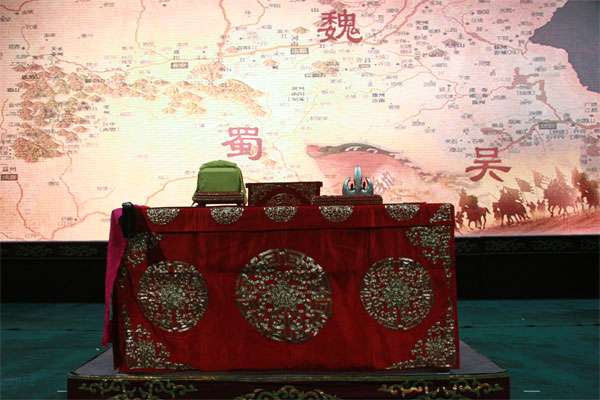
"Three Kingdoms" is unquestionably one of the great epics of Peking Opera. This time around, however, the repertoire Jiang staged is more than a mere interpretation of the classic piece. Instead, rather, the production was a full-blown effort to pull the faltering genre out of the mire.
A three-day run of "Three Kingdoms" at the Chang'an Grand Theater on Feb. 24-26, sponsored by China National radio, added a storytelling component to shed light on the piece's esoteric dialogue to new audiences. The run featured famous storyteller Lian Liru as well as Jiang and numerous other Peking opera legends.
Wang Yu, one of the production's key organizers, said such new variations were necessary to revive interest in Peking opera.
"Indigenous operas are usually prone to the dilemma in which numerous audience members find nowhere to satisfy their enthusiasm while the performances face empty seats," Wang said.
On the streets of Beijing, there are signs that the mysticism of Peking opera is out of touch with modern times. One 30-year old man, who asked not to be identified, said the genre can hardly keep pace with the modern world.
"I listened to Peking Opera from radio when I was a junior student in my middle school. To understand its lines, I read the script of 'The Three Kingdoms' in particular, but consequently forgot them all," the man said.
"I couldn't understand what they were singing, besides, I was bored when they spent five minutes on one sentence," he said.
Storytelling, as much as Peking Opera, faces an uncertain future as its audience declines.
Jiang recalled an era where the mainstream market had not yet been dominated by pop music. "I can still remember the days when I clutched a lunch box while squatting beside a radio tuned to the voices of my favorite storytellers," he said.
Despite the arguments of some critics that Peking Opera is "dead", the "natural death" of the art form is by no means acceptable to the opera performers.
"Every country is symbolized by its own culture," said Meng Guanglu, a senior actor from the Tianjin Youth Peking Opera Troupe, "Peking Opera is one of those [art forms] maintaining the originality of Chinese culture, characterized by the Confucius thoughts ingrained deep in our bones."
"There are so many people who criticize Peking Opera but haven't looked at it at all," Meng said.
But opera performers also reckoned that the genre needs changes as well as a marketing strategy to cultivate a new generation of fans.
"Peking Opera should be refreshed by new elements, like tightened rhythms and storylines," Meng said. "It should be innovated in terms of its style."
Guided by Lian's storytelling, China National Radio's re-invented opera has the potential to usher in a monumental resurgence for the genre, Jiang said. "It is an exploration, with the two traditional art forms dovetailing tactfully with each other, supplementing either's insufficiencies while sharing similarities," he said.
Chen Shaoyun, a veteran actor of the Qi group from the Shanghai Peking Opera Troupe, said the revival of the genre will require production companies to be more diligent in their promotional efforts.
"Multitudes of students surrounded us when we campaigned for the Peking Opera in Fudan, Tongji and Shanghai Jiaotong Universities," Chen said, indicating the potential audience remains large. "But we don't make regular visits; that's what we should have."


Go to Forum >>0 Comment(s)