China's Central Bank Governor Zhou Xiaochuan Friday outlined six possible scenarios of adjustments for global economy to achieve balance.
Zhou was speaking at the Global Think Tank Summit that opened Thursday in Beijing.
 |
|
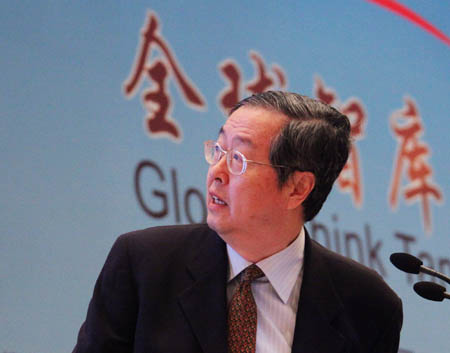
Zhou Xiaochuan, governor of the People's Bank of China (PBOC), delivers a speech in Beijing, capital of China, July 3, 2009. The global think-tank summit opened here on Thursday has attracted more than 900 scholars, experts and representatives from business circle around the world to discuss remedies for the global financial crisis and the future development of the world economy. [Xinhua] |
He stressed a problem that countries with relatively low incomes were saving too much, while those with relatively high incomes were spending too much.
"One scenario is what we've talked about a lot and the most desirable, namely the global imbalances will be corrected, should US households' saving rate and overall saving rate rise and Chinese consumer consumption increase," Zhou said.
But the effects of the two countries' efforts should not be overstated, Zhou said.
Another scenario was the U.S. households' saving rate rose and the United States did not need as many Chinese exports as before. Thus China would suffer production overcapacity and enter a period of low growth, Zhou said, adding that this was what China should avoid.
The third scenario was US households' saving rate rose and China's consumer consumption grew but not high enough, while China invested more in urbanization, leading to dwindling surplus savings and savings outflows, Zhou said.
"This is also an acceptable option. It would support future consumption and employment through building urban infrastructure, housing and service industry," Zhou said.
Zhou said the worst scenario was all the efforts failed and the global economic imbalances persisted and trade protectionism grew worse.
Zhou believed a feasible way out for China might be the country expanded consumption and improved urbanization, but would still have surplus savings because its saving rate base was too high.
"I hoped more China's surplus savings could flow to other developing countries," Zhou said, adding that it could boost global production rate and maximize revenue allocation.
Zhou said it was impossible to redress imbalances with simple tools and more attention should be paid to micro causes that lead to financial crisis while focusing on macro levels.
(Xinhua News Agency July 4, 2009)