Who took our money in 2011?
- By He Shan
 0 Comment(s)
 Print
Print E-mail
China.org.cn, January 3, 2012
E-mail
China.org.cn, January 3, 2012


 |
|
Editor's notes: China's economy turned in by far the strongest performance among the world's major economies despite of a cooling down trend, but people feel that their wallets were pinched by higher consumer prices and anemic stock, commodities and property markets. Evidently, fast overall economic growth does not necessarily translate to dividends for individuals. This article aims to shine a light on those who made and lost money in 2011. |
Volatility, thy name is stock market
The stock returns this year were quite disappointing. The Shanghai Composite Index lost almost 23 percent of its value since January. On Dec. 14, it fell to as low as 2245.87 before closing, nudging at numbers from a decade ago: 2245 on June 14 2001, the highest level that was not surpassed until in 2006.
A comparison chart of world major indices in 2001 and 2011
|
Countries and Regions |
Index |
2001 (Average) |
Current (Dec. 27) |
Change (%) |
|
United States |
Dow Jones |
10,021.6 |
12,291.30 |
23% |
|
United States |
Nasdaq |
1,950.4 |
2,625.20
|
34% |
|
UK |
FTSE 100 |
5,217.4 |
5,512.70 (Dec. 23) |
5.7% |
|
France |
CAC 40 |
4,624 |
3,103.11 |
-33% |
|
Germany |
DAX |
5,160.1 |
5,889.76 |
14% |
|
India |
BSE Sensex |
3,262.33 |
15,874 |
386% |
|
Brazil |
BOVESPA |
13,577.6 |
58,005.20 |
327% |
|
South Korea |
KOSPI |
693.7 |
1,842.02 |
165% |
|
Kong Hong |
HSI |
11,397 |
18,632.89 (Dec. 23) |
63% |
|
China |
Shanghai Composite Index |
2,245 |
2,166.21 |
-3.5% |
Amid the turbulence of this year's stock market that took a decade-long backward step, most investors lost money, leading to the question: If stock market is a zero-sum game, then who were the winners in 2011?
Some said funds shorting Chinese shares were victors in the market this year. But analysts said it is very risky to short China's stock market, because China's trading platform has so much clout that none of the multinational securities groups would offer synthetic ways to express negative views on shares that trade only in China, according to a FT report.
Amid the gloom, however, some took advantage: companies that went public this year. Newly listed companies made a host of the ultra rich, mainly investment bankers and founders of the firms who cashed out of their stake at the right time.
The stock market is a factory that never stops churning out overnight millionaires and billionaires. Among 316 people who made the list of richest people who got their companies listed on China's A shares, 295 were owners of companies that recently went public, representing 93.4 percent, a report released by the Beijing-based China Business News found.
Housing market, a cat-and-mouse game
The housing market in 2011 was a cat-and-mouse game. The central government cuffed the overheating market with rigid measures to bring property prices down to a reasonable level, while the developers drummed up support for more lending so they could sustain their businesses.
The government's limitations on purchasing a second-home immediately caused outcry from developers and speculators who lost resale value on homes after the prices declined. They held a string of protests against discounts offered by real estate companies to buyers in Shanghai, Beijing and other cities that were experiencing a sharp decline in property prices.
Dozens of protesters gathered outside of China Vanke's headquarter in Shanghai in mid-December, demonstrating against declining home value and demanding refund of the down payments from China's largest developer in terms of market value.
A protester surnamed Lin said she paid 152,000 yuan in July for an 95-square-meter apartment in a building developed by China Vanke, only to find the home value declined to 114,000 yuan months later after the developer slashed the prices by 20-25 percent as a result of government cooling measures.
China Vanke Co. was consequently hard hit this year. The company reported its biggest year-to-year slump in sales in November, signaling a turning point for China's real estate market.
Yet the government's good-willed intention jarred with wishes of a considerably large group of people. A report jointly released by the China Center for Financial Research (CCFR) at Tsinghua University and Citi Foundation showed that despite the government's rigorous measures, 58.67 percent of home-owning families still expect a slight rise in property prices, while only 5.94 percent of them expect a slight drop.
Gold losing luster?
Precious metal went on a roller-coaster ride over the past year. In the first eight months, gold prices kept perking up before it reached a record high of US$1,921 an ounce on Sept. 6. Then prices fell to about US$1,540 at the end of 2011, as shown in the chart below.
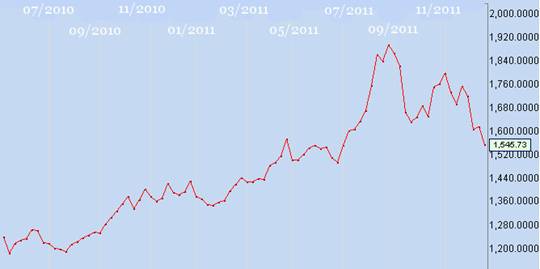
The volatility only proved that gold is merely a commodity rather than the supposed "investor's haven."
Are the analysts who predicted that gold would surge to US$2,000 and never expected a fall to blame? The answer is yes and no. Those who entered the market when it was at its September peak would have suffered terrible losses, but had someone invested in gold at the outset of 2011, the return would have been an amazing 40 percent in September. People who did not hop out then would still come out with a slight gain at the end of the year.
Gold was still the only precious metal ending the year above waters.
Inflation erodes our egg baskets
Although fears for higher prices have eased, inflation remained a headache for the average people. High consumer prices not only threaten China's status as the low-cost factory for the world, but also shrivel our wallets.
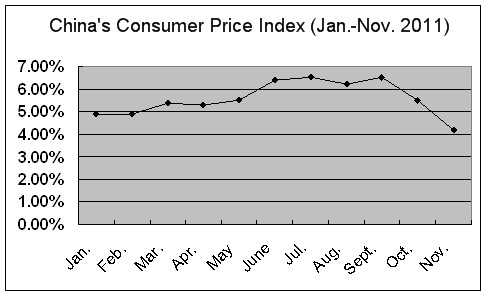
The government is engaged in a tug of war between the need to encourage sustainable growth and its struggles to control rampant inflation. The conundrum is that if the government cuts the already relatively high interest rates, it would please property developers, exporters and average borrowers, but inflation will certainly rear its ugly head, leaving people spending more on the same goods and services.
Li Minjie and her husband Ren are an affluent couple by China's average income standard. Their annual household income is US$40,000 – almost three times the national average for urban families.
But they still have to be frugal due to high living costs in Shanghai. The couple owns a two-bedroom apartment in the metropolis, paying US$2,000 a month in mortgage out of their combined monthly paycheck of US$3,300.
They seldom go out for dinner and don't have a car. Nevertheless, they find it very hard to save money.
Moreover, they have a three-year-old child. After paying mortgage, the couple needs to spend one third of their disposable income on the child's education, clothing, food and other sundry items.
"I hope my hubby and I will be promoted and get a raise next year and pay off the debt as quickly as possible," Li said. "In that case, we may be able to take our son to Hong Kong for a vacation."


Go to Forum >>0 Comment(s)