Miners battle lung disease in hazardous mine
 0
0 


 |
|
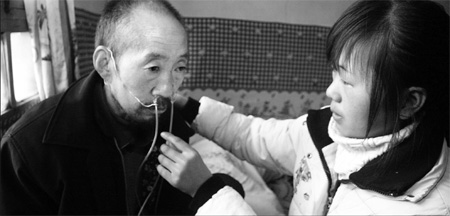
Chen Liping helps her father Chen Dejin, who suffers black lung, with his respirator. The 50-year-old man was among 304 farmers from the isolated Gulang county in Gansu province diagnosed with the occupational disease after working for several years in gold mines. Few wore protective masks. [China Daily] |
Ma lives with his wife, children and aging parents-in-law in Miaotai, a remote village at the foot of what locals call Pingding Mountain, an offshoot of the Qilian Mountains that extend to the Qinghai-Tibet Plateau. The community has been devastated by black lung.
Although its residents are friendly, Miaotai is a depressing and unwelcoming sight. Its streets are lined with houses built from loess and have thatched roofs, while the air is thick with the odor of cow dung, which residents burn to heat their homes in winter.
Ma's home has only one electrical item: a 1970s radio, which sits on a table covered with a sheet of red cloth.
Families here have struggled to make a living for generations. The area is often hit by drought and suffers a chronic water shortage. Although farmers toil mercilessly in the fields, their harvests are reliant on summer rainfall and do not always meet demand. "We have no choice but to travel to Subei to work in the mines," said villager Liu Zhongxi, 42. "We need the money, so all we can do was bear the dusty and dark conditions."
Ma developed a cough in 1989 but did not go to see a doctor until 2002, when he began struggling for breath and had severe chest pains. Tests at Wuwei People's Hospital showed he has black lung. He had surgery to clean his lungs in 2005 at the No 1 Hospital affiliated to Lanzhou University, but the treatment failed to cure him. He is now unable to work on his land or around the house, and takes only traditional Chinese medicine to alleviate his crippling symptoms.
The father-of-four was the first of the 304 Gulang residents diagnosed with black lung. County officials have since arranged for more villagers to undergo tests in Wuwei, the administering city, but the results are still to be announced.
"We are waiting for the findings of the tests but the patients need treatment as soon as possible," said Wang Jiancai, director of the Wuwei Disease Prevention and Control Center.
Reports of black lung among farmers highlights gaps in the government's supervision to ensure healthy working conditions, said Zhai Yujuan, a law professor at Shenzhen University in Guangdong province.
The separation of responsibility between labor and health bureaus at county level and below makes it almost impossible to properly monitor the safety of some workplaces, particularly mines, he said. "Labor bureaus are responsible for work safety, while occupational health is supervised by health bureaus. This division has reduced efficiency in protecting workers' rights."
The owners of the gold mines do not provide protective masks to prevent workers from inhaling the thick dust, said former staff. Shang Zhihu, 41, who lives in Miaotai estimated about 80 percent of farmers from his village worked without protection while drilling ore in Subei.
Han Guofu was one of the few exceptions. The 47-year-old said he and five other workers bought special facemasks before going to work underground. However, the gear did not prevent Han from also developing black lung.
There are three major mines producing 750 kg of gold every year in Subei, as well as more than 15 smaller operations dotted around the county.
Most mine owners were not available for comment when contacted by China Daily. However, Xie Changjun, who runs a gold mine in the county's Mazongshan township, said he did not make a profit before 2007 and could not afford to buy his 200 workers protective masks, which cost about 8 yuan each.
"To be honest, I didn't realize there were such terrible risks to underground drilling. Also, workers don't wear masks because they don't think they are convenient," he said.
Under the Law on Pneumoconiosis Prevention and Control introduced in 1987, governments at county level and above are responsible for preventing black lung and for punishing mines that do not protect workers. This means officials in Gulang have no authority over facilities in Subei and can only help affected families get compensation.
The Gulang government was sent a report on black lung from Heisongyi township last April and its labor bureau contacted Subei in late August. As of Jan 24, Subei still had not responded, according to Gulang officials. No one with the Subei government was available for comment when contacted by China Daily.
"The lack of communication between departments makes it harder for villagers to assert their rights and claim compensation," said Lu Huilin, a sociology professor at Peking University.
Farmers are further hampered by the fact they did not sign contracts with the mine owners. Few villagers in the impoverished area receive higher education, while most women are illiterate, so their knowledge of employment law is extremely limited.
"Farmers were only hired as temporary labor at the mines because we had to be back in our village for harvest in the autumn," explained Li Tingde, 46, who worked as a driller in Subei for three years in his 30s. "Everything was done through verbal contracts."
Gulang officials said they are collecting evidence of employment relations.


Go to Forum >>0 Comments