Residents struggle as cold weather heads south
 0
0 


 |
|
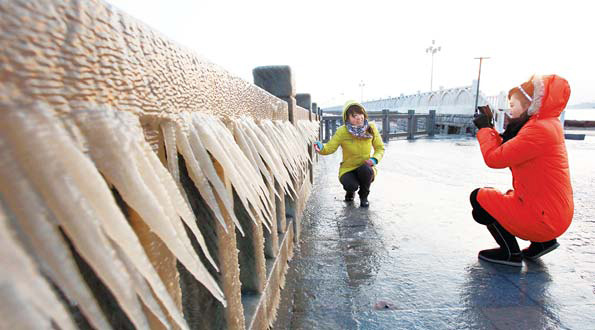
Two women take pictures of the rarely seen ice in Lianyungang, a port city in Jiangsu province. The temperature dropped to - 9 C on Jan 5. [China Daily] |
But you would be wrong.
"It's freezing there," groaned the 35-year-old IT sales manager, who has enjoyed the warmth of the capital for more than seven years. "Shanghai has no citywide central heating system like Beijing, so if we don't switch on the air conditioner it is unbearable.
"Two sweaters, a waistcoat and a down jacket; I need to wear more clothes when I'm in my parents' home than when I'm outside."
Wang said he has even decided to cut his holiday short so he can return to his heated apartment.
"I really want to spend time with my parents but the freezing cold - which honestly chills me to the bone - makes me count the days until I leave for Beijing," he said.
Wang's feeling is shared by millions of people who live south of the Qinling Mountain-Huaihe River line, a boundary drawn by the government in the 1950s. Areas below the line, which often experience freezing temperatures in winter, do not receive central heating.
China this year saw one of its worst winters in decades. Heavy snow caused chaos with the nation's transport networks, while citizens braved biting winds and frozen sidewalks. But while the majority above the Qinling Mountain-Huaihe River line had homes warmed by State-run heating plants, those below enjoyed little respite from the cold conditions.
Central heating systems in North China are largely fueled by coal and gas furnaces, or by oil boilers, and the heat is transferred to surrounding buildings via a series of pipes. The plants are believed to be better for heat efficiency and pollution control. Beijing District Heating Group, the biggest in China, covers an area of more than 34 million sq m.
"In Chinese history, Qinling Mountain and Huaihe River mark the geographical north-south boundary. Most people think the north is cold and the south is warm, but that is not accurate," said Chen Zhenhong, a researcher for the Hubei provincial meteorology bureau. Humidity plays a large role in sensory temperature, he said, explaining that for every 10-percent increase in humidity, a person's natural sense of temperature drops by about 1 C.
"The humidity of cities along the Yangtze River stays at 70-percent humidity on average in winter, while northern cities are only 20 to 30 percent. It means the actual temperature southern people feel is 5 C to 6 C lower than what people in the north feel," he said.
The decision in the 1950s to establish central heating only in the north was "a money-saving move because the State provided heat as part of its welfare package", according to Xu Guangjian, vice-president of the school of public management at Renmin University of China.
"Housing and heat was free until the housing reform started in the 1980s. Although free heating ended, the north-south divide remained," he said.
This is not the first time in recent years South China has been hit by a severe cold snap. Snow may not often fall south of the Yangtze River, but the winter weather still impacts on residents' lives and many are calling for cities to install new central heating systems.
"The division for central heating was just temporary, so this so-called boundary should be abolished to keep pace with China's development and the overall improvement in living standards. Residents deserve to enjoy a comfortable life," said Wang as he prepared for his journey home. "Officials should send staff with technology to investigate the real temperatures and people's needs, while local authorities should work out a way of solving the demand for heating."
The shortfall in central heating has proved a boon for manufacturers of air conditioners. More than 23 million units were sold last year, with sales expected to top 25 million in 2010, according to figures from the State Information Center.
"We installed air conditioners in both bedrooms and our living room," said Wang Aiping, 56, of Nanjing, capital of Jiangsu province. "My husband and I work and are not at home during the day, but we fitted them because my 82-year-old father lives with us."
Her family pays on average about 230 yuan (US$33) a month in electricity bills, but that can rise to as much as 700 yuan when they run the air conditioner for five or six hours a day.
"Room temperature can go below zero but my father still tries to save money by only turning on the heating about 10 minutes before my husband and I return from work. He'd prefer to just wear more clothes than use the electricity but I'm worried about his health," said Wang.
Many elderly people have taken to spending their days wandering heated shopping malls to stay warm, she said. "I've seen lots of older people with chilblains on their hands."
The plight of those suffering during winter months has not escaped the attention of deputies to China's many local people's congresses.
During the annual session of Hunan Provincial People's Congress, deputy Wu Hezhi proposed establishing a central heating system in the province based on the evidence that South China has a higher rate of rheumatism and arthritis, as well as cardiovascular and skin diseases, because of the cold and wet weather.
As well as air conditioners, those who can afford the extra expense are turning to electric heaters and blankets to stay warm. Poorer families rely on coal or wood-burning stoves, although the fumes they produce can cause carbon monoxide poisoning in unventilated rooms.


Go to Forum >>0 Comments