Residents struggle as cold weather heads south
 0
0 


"Setting up a central heating system would not only increase the quality of life but it is also good for rational energy consumption and pollution control," said Wu, who urged the government to make the project a No 1 priority. "The government needs to enhance the study and use of clean energy, such as nuclear, solar and geothermal power, to reduce the dependence on electricity and decrease emissions of carbon dioxide and sulfur dioxide."
Officials in Nanjing have already unveiled plans for a massive central heating project next year. The system will involve surplus heat generated by the city's thermoelectric power plants being pumped to surrounding residential areas, according to new regulations.
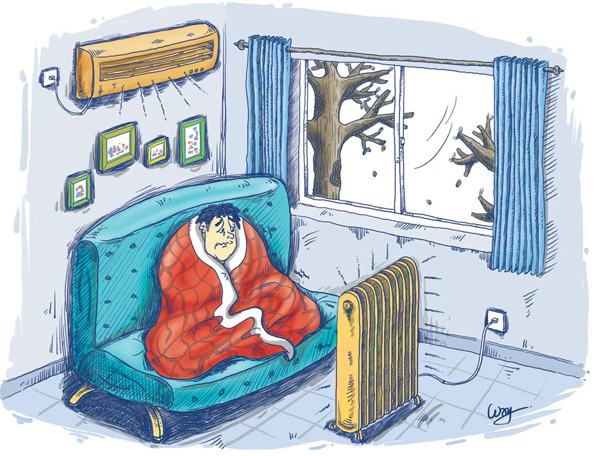 |
|
By Wang Xiaoying [China Daily] |
But many challenges still lie ahead if the city wants to spread its central heating coverage, said Mei.
One problem is that local authorities would prefer to generate heat through thermoelectric power stations because coal causes energy wastage and pollution. But establishing new plants in areas that do not have them would be expensive, with each 600,000-kilowatt station costing roughly 2.9 billion yuan.
Finding the right location for new plants would also be difficult. Residents could object to stations being build close to their homes, and if they are too far out the cost of transferring the heat will soar.
As almost no buildings in the south have central heating, setting up a system would mean a massive investment, said Mei.
Authorities in Wuhan, capital of Hubei province, and Hangzhou, capital of Zhejiang, are also planning heating networks, according to China-heating.com, a website for information on heating products.
Nanjing has experimented with central heating before. In 2005, the Sunshine Yaju residential community began to take heat from the nearby No 2 Thermoelectric Power Station and charged households 7 yuan per sq m. However, only a sixth of households agreed to pay for the service, which was eventually scrapped.
"We looked at building a centrally heated community but the cost was just too high. The concept still needs time to develop," said the owner of a real estate firm in Nanjing who declined to give his name.
For some people living below the imaginary line between Qinling Mountain and Huaihe River, the cold has just become a way of life.
"I've lived in Shanghai for 20 years, so I am already used to the winter weather," said retired doctor Li Changfen, 63. "As long as you do not stay in one place for too long and wear enough clothes, the cold is not that bad. If you really feel it is too cold, just turn on the air conditioner. The cold season is not long, I don't think we need central heating."
The issues of central heating is the problem left over by history, said experts, who warned that establishing systems in more southern cities is no easy task and would not be realized overnight.
"The whole idea still needs more work. Officials must realize that walls of buildings in the south are generally thinner than in the north, and windows are single glazed. It means buildings struggle to store heat," said Professor Xu Guangjian. "Any construction would be a big project. If developers transfer the costs to the consumers, will they be able to afford it and would they want to pay for it?"


Go to Forum >>0 Comments