'My kind of town'
 0
0 


Shanghai is widely regarded as the most liberal city on the Chinese mainland and part of the reason for this its colonial past.
|
|
|
Regarded as the most liberal city on the Chinese mainland, Shanghai's early exposure to the outside world has given it a high tolerance for new ideas. |
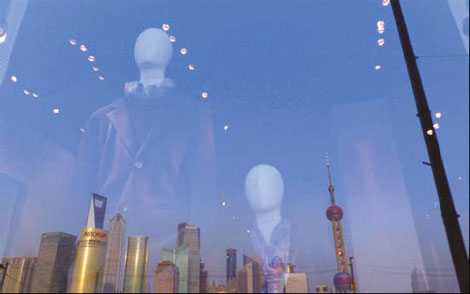
One of the first so-called "treaty" ports, Shanghai gained early exposure to the outside world and developed a high degree of tolerance toward foreign cultures and new ideas.
Chinese flooded in to work as laborers, bookkeepers and shopkeepers, while European, American and Japanese business people built banks, commercial enterprises and factories.
By 1950, nearly 85 percent of Shanghai's population was made up of immigrants from other provinces. The expatriate community was made up of people from more than 40 countries.
They introduced their own lifestyles and a lively social scene and various artistic activities reflected this.
Shanghai's characteristic style, or haipai, is known for being worldly, broadminded and, in a less flattering sense, pretentious and vain.
Shanghai people feel justly proud of their city's tradition as a shelter for people persecuted elsewhere. For instance, it accepted more than 30,000 Jews from Nazi Germany between 1933 and 1941.
"Nobody should feel discriminated against in Shanghai," says professor Qian Nairong, from Shanghai University.
Shanghai's willingness to embrace foreign culture inspired Sam Jacobs to relocate his design studio from London to Shanghai in 2006, with his partner Lin Lin.
"It's not something we had planned," says the 29-year-old Briton. "We were quite happy working in London at that time, but from what I saw during my very first trip to Shanghai - just on the way from Pudong airport to central Shanghai, I decided to move.
"It was just something you could feel in the air. It was special," Jacobs says.
Jellymon, Jacobs' studio, keeps close watch on the fast-growing Shanghai youth market and says one of the company's most successful collaborations was with Shanghai Watch.
"We had this idea that we wanted to work with an old Chinese brand, preferably a State-owned Chinese brand, because it hadn't been done before. It (harks back to) those times when there was less influence from outside and makes people feel nostalgic," Jacobs says.
For the dancer and choreographer Jin Xing, Shanghai's environment is liberating and inspiring.
"It's an environment with no political overtones and an audience with no sexual prejudice."
"I call it home," she says.


Go to Forum >>0 Comments