Lifting the lid on China's antiques 'mess'
- By Lu Na
 0 Comment(s)
 Print
Print E-mail
China.org.cn, November 18, 2011
E-mail
China.org.cn, November 18, 2011


|
|
|
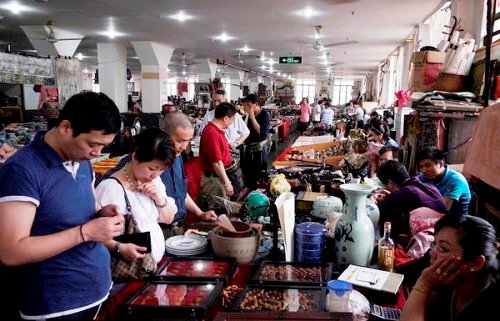
In the case of the first level market, the trading model follows traditional patterns. [CFP] |
Wu Shu, a famous Chinese writer, who is regarded as the "deep throat" of China's antiques industry, revealed the incredibly shady world of antique dealing and collecting in the final book of his trilogy about the antiques industry in China. The first two books were very popular in China and were regarded as "encyclopedias for understanding China's antiques and cultural relics markets."
"After years spent investigating China's main antique markets, I found out about widespread illegal practices throughout the antiques industry, such as inaccurate valuations and pricing and problems with the industrial chain," said Wu Shu.
He added: "In China, there is no overall authority which can identify private cultural relics. The current antiques identification institutions and national antiques identification institutions only work for museums. Each province has identification institutions. However, due to regulations, they cannot identify private pieces."
In other countries such as England and France, some huge museums have held special "appraisal days" to provide free identification for private collectors. In China, as well as a lack of identification institutions, there is also no accepted scientific standard for indentifying and appraising antiques.
According to Wu, those involved in China's antiques industry neither obey the law nor act reasonably. The market is divided into two types: the first level market and the second level market. The first level market includes antiques markets and stores and the second level market refers to auction companies. In the case of the first level market, the trading model follows traditional patterns. So, if a buyer purchases a fake piece, they have no choice but to take the loss and chalk it up to experience.
Buyers are faced with a similar situation when purchasing items from auction companies. This is because Article 61 of the Auction Law acts as an exemption clause and states that should an auctioneer state prior to an auction that that they cannot guarantee that an item is genuine, they bear no liability or responsibility for the item post-auction.
"Shall we strictly enforce the law or modify the law? We have to choose one. According to my statistics, 95 percent of collectors who bought fake pieces were unaware that they'd bought fake pieces and were originally happy with their purchases. Who is going to take responsibility for these people?" said Wu.
Wu added that China's antique markets lack an efficient and complete system of administration. Government administrative departments only act against those who sell unearthed relics, not fake ones.
According to Wu's survey, China has over 80 million collectors (the China Association of Collectors puts the figure at about 100 million). Experts from the Chinese Academy of Social Sciences have also claimed that there are almost 100,000 people involved in grave robbery, with more than 2 million graves being robbed over the past three decades. Wu also calculated that, in total, private collections contain 33 times the number of relics found in China's museums.
The numbers trouble experts. "If all Chinese start buying and selling antiques, the antiques market will become a mess," said Deng Baochang, one of China's leading authorities on pottery and porcelain.
Most people, though, don't make a fortune collecting antiques. Those who do tend to fall into two categories: Wealthy speculative traders and corrupt officials. Such collectors buy real or fake antiques at very low prices from gullible sellers and then sell them for much more.
Such greedy practices have resulted in ancient cultural relics being effectively stolen by traders. The provenance information of some items has been lost as a result of frequent black market trading. As a result, the items become mere art wares, and lose all historical and cultural value.
In addition, the antiques industry has been inundated with speculators, looking to collect items as an investment. This has led to crimes such as fraud, as collectors and sellers look to maximize profits at all cost, and left China's antiques industry in chaos.


Go to Forum >>0 Comment(s)