SE Asian gateway hosts trade fair
- By Corey Cooper
 0 Comment(s)
 Print
Print E-mail China.org.cn, April 14, 2012


Where can you find cosmetics and incense from Thailand, handmade Laotian bamboo stools, jewelry from Myanmar and Pu-er tea all standing next to each other in the same aisle? Surely in very few other places other than in Jinghong, in Yunnan Province's Xishuangbanna Dai Autonomous Prefecture, where the city opened its 15th annual Xishuangbanna Border Trade and Tourism fair.
|
|
|
Myanmar zone at the 15th Annual Xishuangbanna Border Trade and Tourism Fair, Apr. 13 in Jinghong, Xishuangbanna Dai Autonomous Prefecture in Yunnan Province. [Photo by Corey Cooper/China.org.cn] |
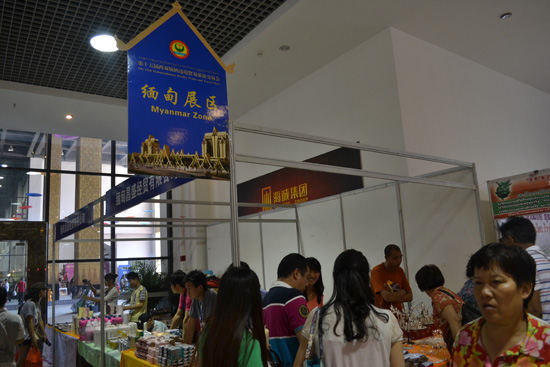
Inside the exhibition center, visitors were treated to a sweeping tour of the best Southeast Asia and Xishuangbanna has to offer: handmade wood carvings, furniture, and baskets from Laos; cosmetics, handmade clothing, and incense from Thailand; hand-strung beads and silver from Myanmar; and tea and coffee from Yunnan.
Outside, hundreds of food vendors filled the air with the wondrous smells of Southeast Asian cooking. Thai staples like papaya salad, sticky rice, and vermicelli with sweet sausage were on offer; as was wild honey from Xishuangbanna, and a huge range of exotic fruit from around the region. A visiting cultural promotion tour group from Taiwan had also set up a row of booths, selling stinky tofu, Taiwanese-style grilled squid, and Kaoliang liquor from the island of Jinmen.
Ever since China established a free trade zone with bordering Southeast Asian countries in 2010 for agricultural products, commodities such as rubber and coal, and handicrafts, foreign companies have benefited from being able to sell their wares in China without crippling import duties.
Cathy Hua, a representative from the Thailand Department of International Trade Promotion, which organized over 50 Thai vendors to attend the Jinghong fair, said that the Department helps Thai trading companies with exemplary business practices to promote their wares in more than ten cities in China each year. Popular Thai exports to China include fruit, decorative items, clothing, cosmetics, and furniture, Hua said.
"We select companies whose products meet the inspection quarantine standards in Thailand and who have experience in exporting," Hua said.
Likewise, the fair is an important showcase for many small-batch producers of tea and coffee, two of Xishuangbanna's most important commodities.
Jiang, a representative for the Puwen Village Coffee Farmer's Collective, located in Puwen, a small village consisting mainly of Nu'ai ethnic minority farmers near the city of Pu'er, said the tiny village has been growing coffee since the 1980s but has only limited production for the domestic market. It has never exported coffee overseas.
"Originally the coffee was used for flavoring or an ingredient in food by the local people, instead of processing the beans for brewed coffee," Jiang said. "These farmers had very little contact with the outside world."
"For other areas with better roads and internet access, doing export business is easier," Jiang said.


Go to Forum >>0 Comment(s)