Women try to hold up half the political sky
 0 Comment(s)
 Print
Print E-mail China Daily, March 8, 2013


When Fu Ying took questions from the media at the opening session of the 12th National People's Congress on Monday, the first spokeswoman in the history of China's top legislative body stole the limelight with her intellectual demeanor and elegance.
|
|
|
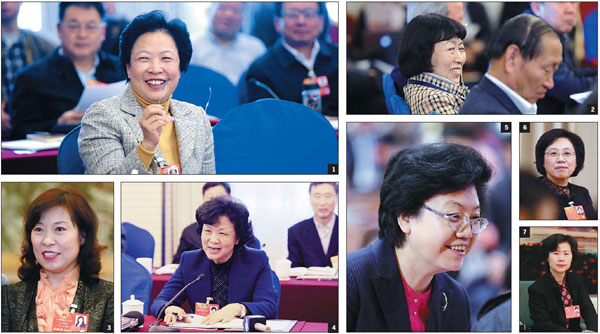
1. Chen Jiwa, chair of the Chinese People's Political Consultative Conference of Guangxi Zhuang autonomous region. 2. Huang Liman, vice-chair of the NPC's Overseas Chinese Affairs Committee. 3. Wang Lixia, deputy governor of Shaanxi province. 4. Qiao Chuanxiu, CPPCC chair for Zhejiang province. 5. Li Bin, governor of Anhui province. 6. Yin Yicui, chair of the Standing Committee of the Shanghai Municipal People's Congress. 7. Zhang Xuan, chair of the Standing Committee of the Chongqing Municipal People's Congress. [Photos/ China Daily] |
By stepping onto the stage, Fu highlighted the growing presence of women in the country's political life, but China still has a long way to go until gender parity is realized in the elite political sphere that is traditionally a male preserve, according to female delegates and experts.
"You can see a growing number of female officials and legislators in China," said Wang Lixia, deputy governor of Shaanxi province and a deputy to the NPC.
Wang was the exception that proved the rule when she joined a group of male deputies for a discussion during the NPC.
Wang, who holds a doctorate in economics, took up her post in the resource-rich northwestern province in January, joining a mere handful of women at ministerial level in China. "We women cherish opportunities such as these and are making great efforts to perform our duties and win respect from society," she said.
This year, the NPC, the most important annual event in China's political calendar, has 699 female delegates, accounting for 23 percent of the total 2,987. The number of female participants has risen by 62 from the group elected for a five-year term in 2008, while the number of delegates remains unchanged.
"You can see a growing number of female officials and legislators in China," said Wang Lixia, deputy governor of Shaanxi province and a deputy to the NPC.
Wang was the exception that proved the rule when she joined a group of male deputies for a discussion during the NPC.
Wang, who holds a doctorate in economics, took up her post in the resource-rich northwestern province in January, joining a mere handful of women at ministerial level in China. "We women cherish opportunities such as these and are making great efforts to perform our duties and win respect from society," she said.
This year, the NPC, the most important annual event in China's political calendar, has 699 female delegates, accounting for 23 percent of the total 2,987. The number of female participants has risen by 62 from the group elected for a five-year term in 2008, while the number of delegates remains unchanged.


Go to Forum >>0 Comment(s)