My China Dream
- By Lisa Carducci
 0 Comment(s)
 Print
Print E-mail China.org.cn, March 31, 2013


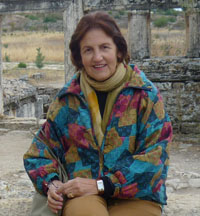
On my first visit to China in 1985, I realized that my one-month stay in the Middle Kingdom was not enough to discover the county's rich culture and heritage, so I opted to extend my visit by an addition of 11 months. Six years later in 1991, I was hired as a French and Italian language teacher at "Er Wai," Beijing International Studies University, where I taught for 2 years and ended my 30-year career in education.
Teaching contracts back in the early 90's were limited to two years, so I left Er Wai and joined CCTV Overseas Programs, and in 1999 switched to Beijing Information (the French language section of Beijing Review) and "Chinafrique," where I stayed until my retirement in 2007.
Despite ending my career in education and moving into the translation and writing industry, I remain interested in following the progress of Chinese education. I published my views on the topic in a book titled Work in Progress in 2011, focusing on the development of education in China. This publication was the result of six years' research, wherein I visited schools to interview teachers, parents and students across the country; analysis of education policy and my own personal experience as an educator in China.
I never write about anything I have not seen with my own eyes, and this is after travelling the whole country, several times, that I wrote the series These Wonderful People of Xinjiang¸ as well as of Ningxia, Guangzhou, and Inner Mongolia. Since 2003, I've tried my best to support cultural and educational projects of Tibetan communities in Qinghai, and have paid university fees for two girls studying medicine. This experience is reflected in the book My Tibetan Daughter.
China has been developing rapidly over the past decade, but the field of education has not developed alongside the rest of the country, causing many Chinese students to study abroad. This is a bad thing for China for a number of reasons: many will never return; those who do may be unprepared for the local market; the huge sums of financial resources invested abroad could be better used to improve domestic education.
When I was teaching in China, innovation was seen as suspect. For example, I encouraged my students to take part in a poetry contest in Italy, and one girl won a prize; a boy wrote a letter to the China Daily on behalf of his classmates, and the letter was published. But I was accused by the authorities of having posted the news myself: "Students must not be distinguished from others," I was told.
When I came to China, my children were already living on their own, and I had just become a grandmother of twins. I never felt alone as letters came and went regularly. In my first six years in China, I spent more on postage stamps than on food. The Internet arrived in 1997.
When people abroad discovered that my monthly salary was then only 1200 yuan, as a "foreign expert" teaching two languages, they thought I had lost my mind. But I knew what I was doing: not only was I providing China with my part of professional skills, but also getting so much in discovering the culture, the language and the people of China. More, having my roots in Italy but being born in Canada, I had always felt divided between my two countries, but after establishing myself in China I found a new home and China became my motherland. To provide a more precise definition, a motherland is where your heart is, where you feel at home.
I came to China out of "curiosity," but more than my curiosity was satisfied; I received much more than I gave, and my efforts were honored by China's Friendship Award in 2001, and again by a permanent residence permit in China.
I wrote mostly poetry, novels and short stories back in Canada, and only started writing essays after coming to China. I did this because I could not find books on China that would prepare me for living in this eastern country. I decided to fill in this literary gap myself as a way to help others living overseas to understand China. My work has been much appreciated.
But the Chinese were also interested in knowing what non-Chinese thought about their country, so I also wrote for the domestic audience. I compared the Chinese mentality to that of the Western world, warning of the dangers of oversimplification, and showing that "foreign" does not always mean "American."
When China's reform and opening started in 1979, China spent a great deal of money hiring "foreign experts." Unfortunately, many of these foreigners were far from being experts. Many of them were touring China by bicycle, and were hired as teachers just because they spoke English. They were young, had no job in their own country, and were willing to stay longer in China.
Today, the situation has changed, the salaries and life conditions have greatly improved, and more talents are attracted to living and working in China. Still, there are loop holes in the system. For instance, I know a foreign school in Beijing -- with an incredibly high tuition – where not one teacher is "qualified."
Receiving permanent residence is no longer a reward bestowed upon foreigners by the government, but has become something one can earn after living and working in China for a stipulated timeframe. Foreign workers also enjoy medical insurance and retirement pension funds, something that many of us from the 90's did not have access to. China is also becoming more attractive to European and North American youths as their home countries' domestic job markets stagnate.
China has cultivated a strong international image during the past decade, and now leads the world in many fields. International criticism of China is often rooted in jealousy, but I wish that China will continue to grow peacefully. This is my dream for China.
The author is an Italo-Canadian writer living in Beijing.


Go to Forum >>0 Comment(s)