Migrant worker shortage intensifies
- By Lin Liyao
 0 Comment(s)
 Print
Print E-mail China.org.cn, November 12, 2013


|
|
|
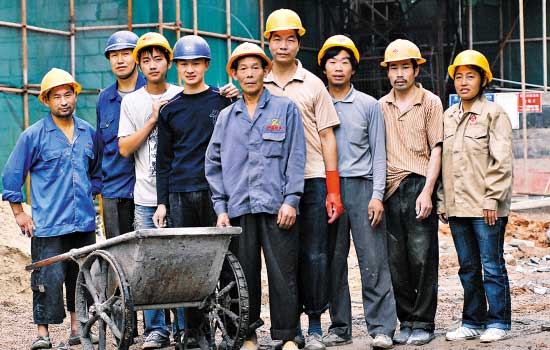
Migrant workers from Hebei Province [Xinhua] |
Although China used to possess a sufficient labor force, the shrinking of its working-age population has begun to cast a shadow upon the nation's economy in recent years.
Data from the National Bureau of Statistics (NBS) showed that in 2012, the number of working-age people in China decreased by 3.45 million to 937 million. According to the Ministry of Human Resources and Social Security, the number will drop by some 8 million every year between 2020 and 2030; after 2030, it will lose 8.3 million each year.
The Chinese Business Daily Economic Information reported recently that labor shortage exists not only in estern China, but also in central and western China. Young adults who stay behind in the rural areas of Zhejiang, Guangdong, Sichuan and Guizhou Provinces are decreasing in number. The labor tug of war is intensifying across the country, causing migrant worker incomes to continually rise.
Supply and demand inverted
The labor shortage in rural areas marks the approach of the "Lewis turning point." At present, the country's labor shortage has extended from its east coast to central and western areas, inverting the traditional relationship between employer and employee.
"In previous years, migrant workers were easily employed. Nowadays, the available rural labor force is declining," said Cao Qiaoqiao, HR manager of a Wenzhou company in Zhejiang Province.
According to statistics from the Zhejiang provincial department of human resources and social security, more than 25 percent of local companies have to face the increasing unemployment crisis caused by the labor shortage.
"When we organized job fair 10 years ago, migrant workers were eager to attend; nowadays, even if you pay them, they may not show up," said a human resources and social security official in Linquan County, northwestern Anhui Province.
In the past four years, the Linquan government has organized a number of job fairs, each of which provided 4,000 to 5,000 jobs. However, it is getting more and more difficult for companies to find workers in counties like that.
In order to gain local government's cooperation, many companies in Zhejiang and other coastal cities even throw in some investment bait. One human resources and social security official in Zunyi County of Guizhou Province gave an example. In 2012, a Zhejiang textile company promised to invest 8 billion yuan in the county, while the local government would have to help hire 5,000 workers in return. However, since only 200 workers had been recruited, the committed investment became a bubble.
Left-behind people become main force
As youth adults leave their hometowns to seek jobs in the bigger cities, the left-behind elderly and women -- or even children -- become the main work force in rural areas.
Li Jianzhong, mayor of Shijian Town in Renshou County of Sichuan, said that the town's working-age population came in at 17,200. Now, 90 percent of them work outside of town, turning adults of 60 or over into the main farming body.
There were about 500 young adults in Bamao Village, Xinpu County of Guizhou Province, but according to village secretary Zhou Yuming, 400 of them are now working in cities. "It's difficult to find a young person in the village now," said Zhou.
In recent years, however, many migrant workers have begun returning home. In addition to getting older, problems such as household registration, social security, housing and education drive them to search for new paths.
Cheng Xianfeng, a migrant worker from Anhui, said that the previous year, he had about 40 to 50 fellow-villager colleagues, but only 10 of them now still work in Wenzhou.
According to human resources and social security officials in Henan, Sichuan and Guizhou Provinces, most of the idle labor in rural areas are women over 45 and men over 55. Because of their rising age and lack of skills, they have a hard time finding other jobs.
Lewis turning point approaches
The intensifying labor shortage has changed the original privileged position of the employer, and meanwhile has leaved migrant workers with more bargaining power.
"Labor shortage provides more possibilities for migrant workers to improve their working conditions and raise their incomes," said Cai Fang, a researcher on demography and labor economy at the Chinese Academy of Social Sciences (CASS). According to his research, since the labor shortage first occurred in 2004, the annual growth rate of migrant workers' wages has reached 12 percent.
The NBS data showed that in 2011, the average monthly income of migrant workers stood at 2,000 yuan, up 21.2 percent year-on-year. In 2012, despite the slowdown of the Chinese economic growth, the number increased by 11.8 percent from the previous year.
In eastern coastal region, a salary increase has become the most practical way to lure workers. Newly published statistics from the Zhejiang provincial department of human resources and social security showed that in recent years, the average incomes of migrant workers in the province have increased by 10 percent annually. At present, half of migrant workers in Zhejiang could earn 2,500 yuan per month, and a quarter of them could earn more than 3,000 yuan monthly.
In addition, according to the NBS, the income gap between eastern and western regions has narrowed down to some 30 yuan per month.
Chengdu company manager Li Zhengjun said that the workers in his company could only earn 1,000 yuan per month in previous years; nowadays, it has become practically impossible to hire anyone for a monthly salary under 2,000 to 3,000 yuan.
China's current labor force is about 900 million, including 260 million migrant workers. Due to the intensifying labor shortage and rising salaries, labor costs have also continuously gone up in recent years.
To address labor shortage, the main task facing the Chinese economy is to find a way of adjusting the nation's industrial structure and promoting steady growth.


Go to Forum >>0 Comment(s)