Chinese urban planning has fallen victim to a recent economic
juggernaut, unwittingly turning into a “modern enclosure movement.”
The land squeeze pitted development zone builders against each
other in the midst of a real estate boom. They make wild land
grabs, driving farmers away as their properties are converted into
walled industrial complexes.
In 2000, the Beijing Municipal Committee of Urban Planning
initiated a plan to build an industrial hub linking Beijing,
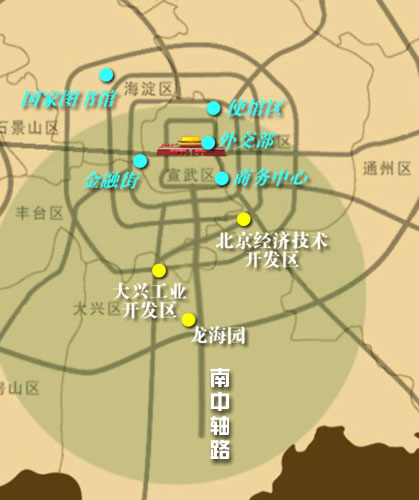
Tianjin and Tangshan. Under the plan framework, Daxing District
situated at the suburb of south Beijing emerged as a promising and
attractive location for industrial development zones.
Since then, a total of 100 industrial development zones have
taken over the district, quickly encroaching on large chunks of
farmland. However, scores of buildings were soon left idle because
of scarce investment.
“In the past, we downplayed well-rounded scientific planning. We
only considered economic development as the paramount task. At that
time, the walled complexes containing factories were common here,”
said Wang Wanxing, a superintendent with the Land and Resources
Department of the Daxing District Government.
In 2003, the area was targeted for a radical shakeup from the
central government in order to protect farmland from urban
encroachment. Land was reclaimed from the zones and reverted to
fields. Adapting to the policy change, sly developers changed their
names or merged with larger zones to evade the regulations. In this
way, the factories could maintain their presence in the zone.
These evasive actions essentially nullified the government’s
efforts, so on March 25, 2004, the Ministry of Land and Resources
resolved to show its teeth by strictly prohibiting merges within
the development zone.
In response, the Daxing District Government conjured up a
program known as the “New Media Base.” The program came as a
solution to protect misfit industrial development zones from the
purge by incorporating them into the base. Lazarus-like, the zones
seemed to find a way of rising.
Other Herculean constructions in the works included the Jing Nan
Logistics Base and the Beijing International Printing and Packing
Base within a stone’s throw from Weishanzhuang Village. The base is
just another version of a development zone, but enjoys more favor
and privileges in policy.
Their differences also lie in the size and function, as the base
is bigger and more diverse. The New Media Base, for example, will
bring together industry, commerce, and accommodations over a span
of 333 hectares.
Traditionally, land in the development zones is allotted for
industrial use while the base can diversify the land use. Compared
with a development zone, a base is approved by the state or the
provincial government and thus seems much safer under their
protection.
The base developers told China News Weekly they were
quite confident in the base’s prospects, saying they would sweeten
the deal with the investors who would stand a chance to get a slice
of hefty governmental grants.
“There used to be a plenty of farmland in the village, but now I
even don’t have a small vegetable patch,” said a 64-year-old
villager brimming with rage. The old man scraped a living out of a
monthly governmental allowance of 300 yuan.
In Dazhuang Village under Daxing’s jurisdiction, the farmers
have been almost completely driven away from the land they lived on
for generations. Last year, the last empty lot in the villager’s
land inventory was snatched by Jingnan Logistics Base to complete
its ambitious blueprint.
(China.org.cn by He Shan, December 14, 2007)