This year's college entrance exam might be over, but discussion about the senior high school curriculum has just begun. The Hunan Provincial Education Department made a new rule on July 13, 2009, requiring all Hunan senior high schools to teach both liberal arts and science courses to students in grades 2 and 3. This has lead to a nationwide debate, as previously only students in grade 1 were required to take both types of courses.
Beginning this fall, all senior high schools in Hunan are required to get rid of the liberal arts vs. science career path curriculums. Instead, students will be required to take courses in both departments. The new rule does not affect the general education system, nor does it change the length of time it will take students to graduate.
The hotly-debated system will be divided into two main parts: required courses and elective courses. The liberal arts and science courses will now be grouped together under the umbrella of the required courses.
 |
|
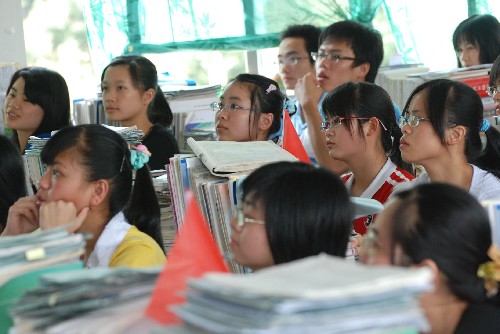
The Hunan Provincial Education Department made a new rule on July 13, 2009, requiring all Hunan senior high schools to teach both liberal arts and science courses to students in grades 2 and 3. This has lead to a nationwide debate, as previously only students in grade 1 were required to take both types of courses. |
Another new aspect of the system is the credit system. Students have to get 144 credits or they will not graduate. Required courses will consist of 8 subjects and a total of 116 credits. This includes: language and literature classes, mathematics, social sciences, sciences, art, physical education and health. As for the elective courses, students must earn 28 credits and can study various topics such as poetry, theatre and music.
In a survey of about 130,000 netizens from a web portal, 54.3 percent believe there should be no division between the science classes and liberal arts classes; 41.8 percent believe the system should remain as it is.
Xie An, a student who has just received admission to Hunan Zhenyan High School with a high mark of 920 (full mark is 1020), opposes the new policy. His mother Luo Xiaohong said her son is an introvert and so she has wanted him to be a liberal arts student since he started middle school. She is dazed by the new rule.
Wang Xueji, a student from Hunan Yiyang No.1 High School, supports the new rule. She thinks a comprehensive education is more fair and beneficial to all students.
Vice director of the Hunan Provincial Education Department Ge Jianzhong explains that the new curriculum structure has two main strengths. First, by combining liberal arts courses and science courses, the school can offer a rich and diverse education, which will help students to develop in more academic areas. Second, the new curriculum structure allows students more chances to choose subjects they like.
Ge says the main purpose is to give students a more comprehensive education. Although it seems there are many changes to the system, the new curriculum still meets the requirements of the college entrance exam and should not negatively affect how students perform. In addition, it lets students choose classes based upon their individual interests.
Yi Lei, a student in class 810 of Hunan Anhua Second High School, is another supporter of the new curriculum structure. He will be in grade 2 this upcoming school year. Yi says under the new system, he won't be bothered as much by one bad mark in a science class.
"I can receive a comprehensive education if there's no division between liberal arts and science courses. I can also have more chances to show more of my academic abilities," says Yi. However, he is worried that he might not have enough time and energy to handle the increased course load.
Li Zhihong, a teacher at Yiyang No. 1 High School, believes that although the new curriculum aims to combine all subjects and provide a more comprehensive education, it actually puts more pressure on both the students and the teachers. "I think a thorough curriculum reform should start from primary schools. The upcoming Grade 3 students should be allowed to take classes under the existing system, which separates liberal arts and science courses," said Li.
Mathematics teacher Wu Yulin, from Changsha Yali Middle School, holds the same view. He says that most grade 3 students, who are already anxious about the college entrance exam, are even more anxious now because they do not know if the new system will change the standard entrance exam. They have no idea what to prepare for next year.
However, Li Rangheng, the director at the media center of the Hunan Provincial Education Department, says students should not worry. "The new curriculum structure aims to cultivate well-rounded individuals, not to add more pressure to students."
Ge says the 2010 Hunan Provincial College Entrance Exam is still in framing, under directions of the Ministry of Education.
(China.org.cn by Wu Huanshu, July 24, 2009)
