Virtual interest
Completed in 1420 after 12 years of construction, the Forbidden City was created to embody the idea of the emperor as the center of the universe and to evoke a visceral sense of his power. Surrounded by a wall more than 30 feet high and 20 feet thick, the walled fortress once served the emperor exclusively but became "a palace of the people" in 1925 when the Republican forces transformed it into a museum.
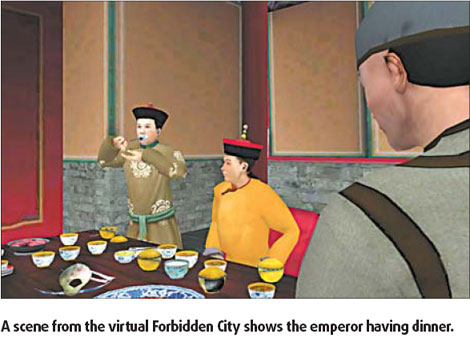
Ever since then, people from across the world have flocked to it to explore the splendor of its architecture, culture and history but constraints of distance and cost have limited the number of foreign visitors.
The Forbidden City receives nine million visitors a year, mainly Chinese, but Hu Chui of the Palace Museum's Information Department says most of them consider it more of a tourist attraction than a museum. "Only a few of them really appreciate the rich culture and history the museum embodies," he says.
Efforts have been ongoing for more than a decade to bring the Palace Museum closer to visitors through up-to-date digital technology but Hu says the $3-million virtual Forbidden City is the most ambitious yet.
"We always aimed to achieve three things through our digital efforts: to introduce the museum to those who have never been to it; to let those who have been to the museum understand more about it; and to allow visitors to learn more about the cultural background behind each of the artifacts and buildings," says the museum's director-general Zheng Xinmiao.
Zheng believes the virtual Forbidden City is a giant stride forward.
The cooperation between IBM and the Palace Museum started in 2005, when the American company was finishing The Eternal Egypt, a collaboration with the Egyptian government providing worldwide access to 7,000 years of Egyptian history.
While IBM was considering its next partner for its cultural heritage project for online visitors, someone suggested the Palace Museum and it seemed ideally suited.
"The Palace Museum is a unique cultural institution," says Paula Baker, vice-president of IBM Global Community Initiatives. "Unlike many others that are based mainly on artifacts, it is focused on architecture, space, buildings and the atmosphere of the imperial court."