Virtual challenge
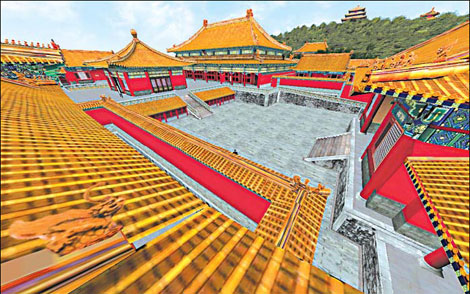
While there was unanimous approval about the chosen site, how to represent the awe and sense of space virtual visitors would experience presented a big challenge for IBM.
 |
|
A three-dimensional representation of the architecture of the Palace Museum
|
"Our earlier ideas were about what to represent on the web and what to do with high-resolution photography and multimedia," says project manager John Tolva. "But the sense of space and scale was missing. That's why we moved on to a gaming technology and a virtual world."
Tolva and his team have also added a cast of characters and a variety of activities and scenes to inject authenticity into the virtual world. Visitors can now conduct a 1- sq-km virtual walk of the Forbidden City.
"But this is not just about walking around," adds Nick Donofrio, an IBM vice-president. "This is about you literally being able to experience the way they lived their life."
Virtual benefit
With links to other virtual communities popular among the Internet-savvy, including Facebook and Second Life, Baker believes the virtual Forbidden City will encourage youngsters around the world to become interested in China's culture and history.
"We all know that young people are very interested in gaming technology and virtual worlds," says Baker. "By exploring the virtual Forbidden City, they will be learning Chinese culture and history without knowing they are learning it."
Baker believes the new site will enable netizens around the world to experience the Forbidden City in a way they would never have otherwise, either through a traditional website or even by actually traveling to China.
"We would never say this would replicate a personal visit," Baker stresses. "People should always try to come here in person but if they can't do that, this would give them a feeling of experiencing it in person when they visit the virtual world."
(China Daily October 16, 2008)