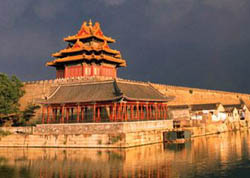
Three thousand years of development and over 800 years being a capital city gave Beijing six major world cultural heritages -- the Great Wall, the Imperial Palace, the Peking Man Site Zhoukoudian, the Summer Palace, the Ming Tombs and the Heaven Temple. They are like scrolls of voluminous books that congeal moments in history and record the tremendous changes in all the years. However, owing to many factors, these "symbols of Beijing" which Chinese people take pride in also face various embarrassing situations in cultural relic protection.
"Please help the Imperial Palace in coordinating and rallying protection of the palace," appealed Jin Hongkui, vice chief of the Palace Museum, to members of the Beijing Committee of the Chinese People's Political Consultative Conference, at a symposium held for China's first Cultural Heritage Day - June 10.
It is learned that due to historical reasons, some cultural relics in the Imperial Palace are now chief collection pieces in Taipei's National Palace Museum, some are preserved in Nanjing, and 2,900 pieces of cultural relics from the Palace of Compassion and Tranquility were lent to Luoyang White Horse Temple in 1973 and still not returned. "We hope these precious cultural relics will be returned to the Imperial Palace according to the requirement of integrality in its protection," said Jin.
According to Li Shuwang, vice director of the Administration Department of Badaling Great Wall, this section of the Great Wall faces the embarrassing situation of unclear administrative responsibility and rights, and indistinct boundary marking, so that some part of the Great Wall and its adjacent environment have long been left unattended.
The threat of desertification and man-made sabotage has covered the Great Wall with scratches. Survey shows that although the Ming Dynasty (1368-1644) Great Wall is known as "ten thousand li" (5,000km), in fact less than 30% of it remains distinct and the overall length of the various sections of the wall and its remains is no more than 2,500 kilometers.
"Urbanization has caused the Summer Palace to be surrounded by high buildings in the east, south and west and this phenomenon is hard to reverse and destroys the landscaping skyline around the Summer Palace," said Zhu Wei, vice director of the Administration Department of the Summer Palace, sadly. In the past, ambient gardens and pastoral scenes created a harmonious scroll of tranquil and splendid landscape in the western outskirt of Beijing with this large-scale natural landscape royal garden.
(Chinanew.cn June 15, 2006)