|
|
Basic Conditions: Municipalities Directly Under the Central Government |
 |
|
|
Beijing |
|
|
|
|
Called "Jing" for short, Beijing is situated at the northwestern
end of the North China Plain. Initially named Ji, Beijing was the capital
of the State of Yan during the Spring and Autumn Period (770-476 B.C.)
and the Warring States Period (475-221 B.C.), and the secondary capital
under the name of Yanjing during the Liao Dynasty (916-1125). It also
served as the capital during the Jin (1115-1234), Yuan (1206-1368), Ming
(1368-1644) and Qing (1644-1911) dynasties and the early period of the
Republic of China (1912-1949), and was called Zhongdu, Dadu, Beiping and
Beijing successively. It was established as a municipality in 1928. |
|
|
Shanghai |
|
|
|
|
One of China's four municipalities directly under the Central Government,
Shanghai, covering 5,800 square km, has under its jurisdiction 18 districts
and one county. Its population with registered permanent residence was
around 17.11 million at the end of 2003. |
|
|
Tianjin |
|
|
|
|
 Called
"Jin" for short, Tianjin is situated in the northeast of the North China
Plain, where the five major tributaries of the Haihe River converge and
empty into the Bohai Sea. Named Zhigu during the Jin (1115-1234) and Yuan
(1279-1368) dynasties, Tianjin was an important place for transporting grain
to the capital by waterway. Later the settlement of a town under the name
of Haijin was built. The settlement became a garrison town named Tianjinwei
(Defense of the Heavenly Ford) in the early Ming Dynasty (1368-1644) and
was the seat of Tianjin prefectural government during the Qing Dynasty (1644-1911).
It became a city in 1928. Called
"Jin" for short, Tianjin is situated in the northeast of the North China
Plain, where the five major tributaries of the Haihe River converge and
empty into the Bohai Sea. Named Zhigu during the Jin (1115-1234) and Yuan
(1279-1368) dynasties, Tianjin was an important place for transporting grain
to the capital by waterway. Later the settlement of a town under the name
of Haijin was built. The settlement became a garrison town named Tianjinwei
(Defense of the Heavenly Ford) in the early Ming Dynasty (1368-1644) and
was the seat of Tianjin prefectural government during the Qing Dynasty (1644-1911).
It became a city in 1928.Covering an area of more than 11,000 square km, Tianjin is now a municipality directly under the Central Government, having 15 districts and three counties under its jurisdiction. Its permanent population exceeded 10.11 million at the end of 2003, including some 9.26 million with registered residence.  Tianjin is the largest industrial city, a major commercial center and a port in north China, with abundant oil, gas and sea salt resources. Famous scenic spots and historical sites in Tianjin include Ningyuan Park, Tianhougong Temple, Dagukou Battery, Dule Temple (Monastery of Solitary Happiness) in Jixian County, the Great Wall at Huangyaguan and Panshan Mountain, known as No.1 mountain east of Beijing. |
|
|
Chongqing |
|
|
|
|
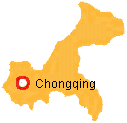 Called "Yu" for short, Chongqing is situated on the upper reaches of the
Yangtze River in the east of southwest China. It was under the State of
Ba during the Spring and Autumn Period (770-476 B.C.) and the Warring States
Period (475-221 B.C.) and was administered by Yuzhou during the Sui (581-618)
and Tang (618-907) dynasties. It was the secondary capital of the Kuomintang
government during the War of Resistance Against Japanese Aggression (1937-45). Called "Yu" for short, Chongqing is situated on the upper reaches of the
Yangtze River in the east of southwest China. It was under the State of
Ba during the Spring and Autumn Period (770-476 B.C.) and the Warring States
Period (475-221 B.C.) and was administered by Yuzhou during the Sui (581-618)
and Tang (618-907) dynasties. It was the secondary capital of the Kuomintang
government during the War of Resistance Against Japanese Aggression (1937-45).Chongqing was designated as a municipality directly under the Central Government in 1997, consisting of three prefectural-level cities-Chongqing, Wanxian and Fuling-and Qianjiang Prefecture formerly under Sichuan Province. Chongqing has under its jurisdiction 15 districts, four county-level cities, 17 counties and four autonomous counties. Covering 82,300 square km, it had a population of 31.3 million at the end of 2003. Of its total population, 41.9 percent were urban residents, a year-on-year increase of 2 percentage points. Chongqing is encircled by Dabashan, Wushan and Daloushan mountains on the north, east and south. The Yangtze River traverses the municipality, cutting through high mountains, forming the famous Three Gorges. Chongqing has an annual precipitation of over 1,000 mm, and is nicknamed a "foggy city" due to its foggy weather in winter and spring. It has rich forest and mineral resources, producing over 1,000 kinds of traditional Chinese medicinal herbs, tung oil and raw lacquer. Home to such rare fauna and flora as Chinese sturgeon and metasequoia, Chongqing is also a comprehensive industrial city and a famous tourist destination. |
|