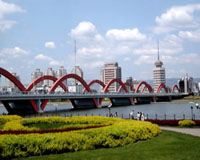
Describing the heavens above the city of Taiyuan, provincial capital of Shanxi, as blue used to be an oxymoron. Local residents now say that sapphire skies are nothing new. What happened?
Once the nation's major coal producer, the city was seriously plagued by air pollution. Standing on top of the 1,500-meter hill to the city’s west, you would find the sprawling conurbation capped in smoke and dust. It is said that one photographer waited on the vista for three months in an attempt to find a clearing to capture a bird’s-eye view. No photo was taken. Due to the thick coating of contaminants hovering over city streets, drivers had to turn on their headlights during the day.
The United Nations Environment Program put Taiyuan on top of the world’s 10 most polluted city list in 1998.
At annual sessions of the Taiyuan Municipal People's Congress, most proposals centered on the smog. The majority of the complaint letters the city government received regarded this problem.
Small and medium-sized enterprises (SMEs) were responsible for 90 percent of the city’s pollution. As coal is rich in the region, small coal mines, coking plants, iron and steel plants, and cement factories littered the outskirts. Some were even centrally located. There were, at one time, 10,000 such operations. Most of them, lacking environmental-friendly technology, discharged profuse amounts of toxic gases, smoke, soot and dust into the air.
The city used to rely on a number of, mostly coal-burning, heat suppliers sprinkled around the city. High chimneys belching black smoke were commonplace, both in industrial and residential quarters.
Statistics from Taiyuan's environmental protection authorities showed that the city’s coal consumption amounted to about 21.5 million tons annually; smoke and soot discharge, over 100,000 tons; industrial dust, 63,500 tons; and sulphur dioxide (SO2), 198,000 tons. The volume of SO2 released was nearly 10 times the standard of the World Health Organization. The per-capita amount of smoke, soot, industrial dust and other health hazards was also several times China’s national average. Worse still, pollutants hung around the city, trapped by mountains to the east, west and north.
Residents were the ones to suffer most from the severe pollution. Many just stayed indoors. Yingze Park, which was meant to be a recreational spot, was virtually deserted at the height of the pollution.
Potential investors were turned off by the pollution. In a letter addressed to the newly elected Party Secretary of Taiyuan, Yun Gongmin, the owner of a private enterprise poured out his grievances. "My partner has withdrawn its capital due to the bad environment [of Taiyuan]."
Something Had to Be Done
Taiyuan initiated an environmental protection program in 2002. A special commission was set up to do something about the pollution, especially air pollution. After consulting environmentalists, the city enacted the country's first regional regulation on clean production.
The city shut down small coal-consuming heat suppliers, beginning with those providing heat to the Party and government offices. In 2002, the two chimneys shooting up from the complex of the Taiyuan Municipal Party Committee were dismantled. A district heating supply network, which burns mostly gas, was installed. The network expanded to cover 6 million square meters by 2003. A total of 139 coal-burning furnaces were demolished and 166 chimneys were torn down. The amount of SO2 discharge subsequently fell by 27,700 tons, with dust contaminants down 45,000 tons.
The municipal government decreed a ban on the heaviest polluters, which failed to meet the city’s environmental protection standards. Qingxu County, south of Taiyuan, used to be the home of many SMEs. Black smoke from the county’s 79 coking plants would drift north to downtown Taiyuan. All its coking plants were closed between 2002 and 2003, despite the loss of 35 million yuan (US$4.23 million), or nearly one-third of the county’s annual revenue. Since 1998, over 9,930 heavy polluting SMEs have been forced to shut down.
While eradicating the sources of the pollution, Taiyuan made efforts to make the city greener. Over 5,000 square meters of buildings around the municipal government compound were razed. In their place, a park was built. After conferring with experts, the municipal government planted a 90 by 30 km forest belt around the city, which has now served as a resort for local residents. It is estimated that the forest, via byproducts of photosynthesis, can purify 1.2 million cubic meters of air every day for the city’s 100,000 residents.
The city's air quality has improved as a result. The concentration of inhalable particles, SO2 and nitrogen dioxide (NO2) dropped 14.08 percent, 15.69 percent and 15.91 percent respectively in 2001. Last year, 153 days were graded Level II or better, according to China's air pollution index. (Urban air quality is classified by five grades or levels: I is excellent; II, fairly good; III, slightly polluted; IV, poor; and V, indicates hazardous.) The city also shook its label of "most polluted city."
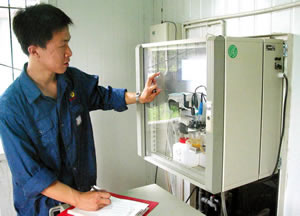
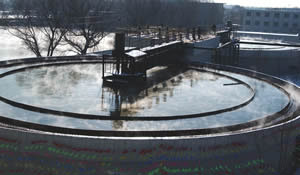
Some 83.3 percent of the city's surface water has reached national standards, a remarkable rise from the previous years.
A Yingze Park employee said, "In the past, the park seemed haunted, with soot covering the ground and tree leaves. Nowadays, the dust is gone and the air is clear. Every morning, over 2,000 people come here to do exercises."
Fenhe River, which flows through the city, used to be a sewage ditch but is now a "birds' paradise." More than 40 varieties of rare birds have made nests along its banks.
"We will make our city more beautiful by stepping up pollution control efforts, so as to meet the residents’ demand for a better life,"promised Municipal Party Secretary Yun.
In order to rein in the pollution caused by the coking plants and prevent closed factories from reopening, Taiyuan's environmental protection authorities carry out frequent inspections in such enterprises. The municipal government has decided to shut down another 50 percent of the remaining coking enterprises by the end of this year.
The municipal government, meanwhile, has pledged to control the volume of discharged pollutants so that all its industries meet national environmental standards by 2005.
(Beijing Review November 6, 2004)