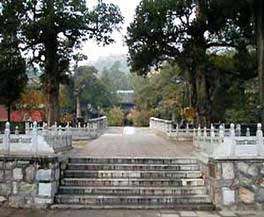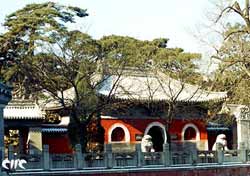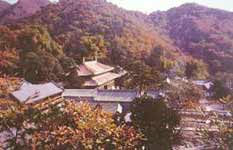
The mountains in west suburban Beijing usually lure many visitors thanks to their cooling resorts in summer and golden scenery in autumn.
But they are not the favorite in winter except those who like a quite surrounding in a Buddhist temple, Buddhist architecture, culture and the special winter scenery hidden within mountains saturated in pine trees.
It is easy to venture on a trip to these temples in winter, concentrated in a 30-kilometre stretch. There is no traffic, no crowds, no noisy pilgrims, only some administrative staff and a few monks peacefully walking around the temples.
One day is adequate to ensure a rudimentary understanding of different Buddhist stories and verified religious architecture.
The temples on show are Wofo, Dajue, Jietai, and Tanzhe. A group of Buddhist temples are also located in the Fragrant Hills, another day's sojourn.
Wofo Temple
Wofo Temple (Temple of the Reclining Buddha) is located inside the Beijing Botanical Gardens, almost 1 km east of the Fragrant Hills.
About 20 kilometers from central Beijing proper, the rear of the temple is set against the mountain cliffs, with its front to open fields.
The temple was first built during the Zhenguan period (627-249) of the Tang Dynasty, when it was also known as Shouansi (Temple of Peaceful Longevity).
It fell into ruin over time and was rebuilt and renamed several times. One of the last major renovations was completed in 1724.
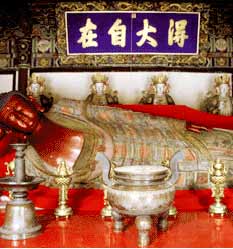
The first structure, the shanmen, serves as the main gate. The second large building is the Devaraja Hall (Hall of the Heavenly Kings) and the third is the Hall of the Buddhas of the Three Worlds. In traditional temples, this would be the largest hall in the compound, but because the fourth hall contains the image of the Reclining Buddha, the situation here is reversed. The famous bronze Buddha is more than five meters long. It lies in a sleeping position, with one arm extended and the other propping up its head, surrounded by 12 smaller Buddhas. According to legend, this scene represents the Buddha on his deathbed giving instructions to his 12 disciples.
Tickets: 5 yuan (US$0.6), but 10 yuan (US$1.2) is required to enter the Botanical Garden.
To get there: Bus 333, 318, 360, 904, or special tour buses from Qianmen. Tel: 6259-1209
Dajue Temple
Dajue Temple (Temple of Enlightenment) stands at the foot of Yangtai Hill, in Beijing's western suburbs. The rolling hills here are sometimes said to resemble a sleeping lion.
The vista of two flanking temples, the Lotus Temple and the Temple of Universal Grace-sitting atop Hills, to the west and east of the Temple of Enlightenment, is popularly described as 'a lion rolling two embroidered balls'.
The principal structures in the temple are the Maitreya (Future Buddha) Hall, with a peaceful courtyard. The roof brackets and columns of the halls date from the early Ming Dynasty (1368-1644).
A mountain spring flows by the Qiyun (Restful Clouds) Pavilion in the rear courtyard.
By the spring is a stupa which stands at the highest point in the temple complex.
On the grounds there is a giant 1,000-year-old gingko tree, a pool formed of giant white stone slabs, and ancient magnolia trees. On the top of the temple is a Liao Dynasty pagoda embraced by a cypress and pine.
Tickets: 10 yuan (US$1.2)
To get there: Take bus route 346 at the Summer Palace to Beianhe Station.
Tel: 6245-6163
Jietai Temple
Located 35 kilometers west of Beijing, Jietaisi, or Temple of the Odination Altar, takes its name from its ornate Ming marble altar. Built some 1,300 years ago, this altar is nearly five meters high and is decorated with delicate and exquisite carvings.
The temple was first built in 622, during the Tang Dynasty, but most of the buildings in this temple date from the Qing Dynasty (1644-1911).
The temple boasts a lot of ancient trees. Most of them are over 1,000 years old, weathered through history, having adopted unusual forms that scholars exclaim over and make legends about.
Unique construction layout, long history and unusual old pine trees make the temple a tourist must today.
Ticket: 35 yuan (US$4.5)
To get there: Take line one subway, or bus route 921, 336, 959 to Pingguoyuan Station and then change bus route 931 to the temple.
Tel: 6980-2232 6980-2645
Tanzhe Temple
Located eight kilometers west of Jietai Temple, Tanzhe Temple has seen numerous monks practice their Buddhist art for the rest of their lives here, thus leaving many pagoda tombs in different styles close by the temple.
Probably the best known is the one of Princess of Miaoyan, daughter of Kublai Khan, of the Yuan Dynasty. In order to redeem her father from killing so many people in battles, she converted herself to Buddhism, and spent the rest of her life here. Her pagoda tomb is a solid brick five-storey construction with elaborate eaves, with a smaller pagoda on each side for company.
Master Dehuada's tomb is a solid stone pagoda like an upside-down bowl, constructed entirely of carved white marble, granite and other precious stones, eye-catching and very different in color from others in grey. The tombs provide an informational resource, both in written language and real objects, to the study of Buddhist pagoda evolution.
Tickets: 70 yuan (US$8.8)
To get there: Same transportation as it to Jietai temple.
Tel: 6086-1699, 6086-2244
(Beijing Weekend December 3, 2004)
|