Keeping the 'Mother River' on course for another century
 0
0 


|
|
|
The Yellow River [Chinaculture.org] |
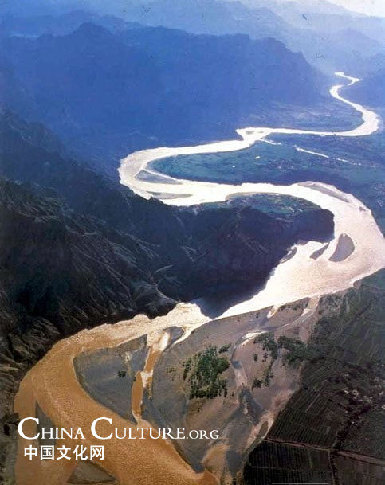
In the past 2,600 years, the dykes on China's Yellow River have broken 1,600 times and the waterway has made a major change in course 26 times.
It has traveled its current course since a dyke burst in 1855, but, with a change each century on average, the river is again feeling restless.
It now claims an arc-shaped river bend about 5.6 kilometers long in Daying Township, Henan Province, after a dyke collapse in 1998 caused the inundation of 247 hectares of land previously owned by the farmers of Xindian and Chengcun Villages.
A survey by water resources authorities showed the Yellow River has edged 300 meters to the south each year over the past decade in Henan.
After 60 years of relative success in taming the world's most silted river, the Chinese government is looking at new ways to keep it in check.
Water management expert Wang Hao, an academician of the Chinese Academy of Engineering, says engineers are hoping to keep the river on its present course for 100 to 120 years.
"Watercourse diversion is a result of natural silt sedimentation, but course changes are hugely costly with the loss of farmland, large-scale resettlement and construction of water conservancy projects," he told the fourth International Yellow River Forum on Ecological Civilization and River Ethics, last month in Zhengzhou.
Wang said China must prepare for a long battle against siltation, dehydration and depletive use of water resources over the next 120 years.
Dubbed the "cradle of Chinese civilization," the Yellow River is a major water source for 160 million people, or 12 percent of the population, and irrigates 17 percent of the country's arable land in drought-prone central and western China.
The Hanging River
Over the centuries, the two major challenges have been siltation and drought.
On its 5,464-km path from southwestern Qinghai Province to the Bohai Sea, the river carries about 1.6 billion tonnes of silt every year, mostly from the Loess highlands in Shanxi and Shaanxi Provinces, giving the river the colour of its name.
Centuries of siltation and dyke-building have caused the riverbed to rise above the surrounding farmland -- by an average of 10 centimeters a year since 1949 -- so that it is often referred to as the "hanging river."
"It is the sediment that makes the river extremely prone to flooding, and forces it to change course," says Li Guoying, director of the Yellow River Conservancy Committee (YRCC).
YRCC researcher Hou Quanliang says the river's dams have been strengthened in four massive projects over the past 60 years to combat siltation.
"The earthwork of the construction was enough to build 13 Great Walls," he says.


Comments