Volunteers safeguard 'lake city'
 0 Comment(s)
 Print
Print E-mail China Daily, December 31, 2012


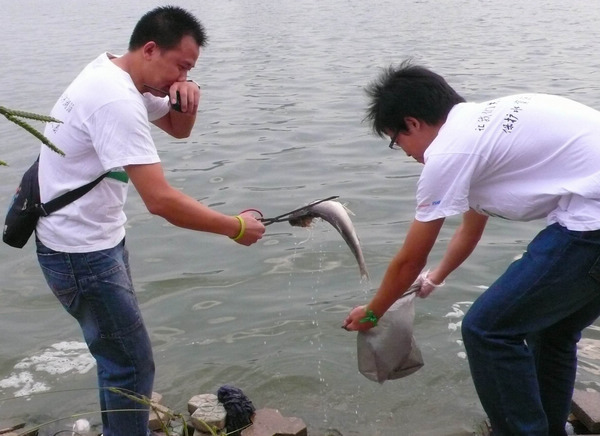
Ke Zhiqiang takes a stroll around East Lake in Wuhan every weekend, but it is not the fresh air or the exercise that draws him there.
Rather than taking in the scenery, his gaze is generally fixed on the lake's surface, on the lookout for trash, dead fish or anything else that shouldn't be there.
 |
|
Ke Zhiqiang, a volunteer with Green Jiangcheng, an environmental non-governmental organization, retrieves a dead fish from a lake with the help of a colleague in Wuhan, Hubei province. [China Daily] |
He is one of 40 volunteer guardians helping environmental authorities to protect the city's many lakes against new sources of pollution and illegal land reclamation projects.
"We act as a third eye for authorities," said the 38-year-old head of Green Jiangcheng, an environmental NGO that since 2009 has organized regular resident patrols around lakes.
"The volunteers are responsible for finding problems and collecting evidence," he explained. "We hand over what we find to the government as well as a local newspaper, which publicizes the problems."
While Wuhan is renowned for its 166 lakes, 38 of which are within the city's core 13 districts, it is also known for its many land reclamation projects.
The city has experienced two major periods of land reclamation, according to a 2012 report by four researchers at Huazhong University of Science and Technology in Wuhan, the capital of Hubei province.
One lasted from the 1950s - when there were 127 lakes in its downtown areas - to the early 1980s, when villagers were encouraged to turn the lakes into farmland or fisheries to meet the needs of the city's growing population.
The other was in the 1990s, when more than 330 hectares of land were claimed, mostly by real estate developers.
The authorities began their attempts to curb the activity in the late 1990s, with the first regulation on lake protection, and penalties for offenders coming in 2002. More than 20 regulations have since been introduced.
However, as land reclamation is cheaper than demolishing homes and relocating residents, even when fines are factored in, the motivation for development companies remains.
"Real estate along the lakes is generally sold at much higher prices than other properties," said Cheng Qi, 23, a volunteer guardian. "Compared with fines by authorities, the profits from a project are much more attractive."
The total area covered by the lakes in Wuhan fell from more than 6,000 hectares to about 5,330 hectares between 2000 and 2010, according to official data.
Efforts to stop the practice have also been hampered due to limited government resources and funding.
Wang Youguo, an investigator for Wuhan Water Authority, wrote in a newspaper article in June that his team has only about 300 members to cover all lakes and rivers.
"Some districts don't even have an inspection team, and only two districts of the core 13 have funding for such a purpose," he wrote.
This has made volunteers instrumental in accomplishing the mission.
The campaign to protect the lakes started in the early 2000s when residents would report anything untoward to authorities through hotlines and volunteers.
The city's environmental bureau officially began working with Ke's volunteer group in 2010 after seeing the impact it had made, largely due to the support of two newspapers and a news website, which ran weekly coverage of the lake campaign.
"Each of the drain outlets, and how construction companies put waste into the lakes, were made public. That's how the problem got noticed by the authorities," Ke said.
"We conducted firsthand investigations into the lakes, and had the facts to hand.
"We gave the media what we had and that's how the government felt pressure. The newspaper wanted the news. That's why they wanted to cooperate with us."


Go to Forum >>0 Comment(s)