Officials monitor plants to clean up the environment
 0 Comment(s)
 Print
Print E-mail China Daily, February 18, 2013


For Xiao Liyang, 53, who has lived his whole life in Zhuzhou, the decision to move and change his job came in 1992 because of the terrible environmental quality.
Xiao, who then worked in a chemical plant in Shifeng district, where many factories and businesses are located, said the air was filled with smoke dust and smelled sour in the 1990s.
|
|
|
Smoke rises in an industrial zone in Zhuzhou of Central China's Hunan province in March last year. [China Daily] |
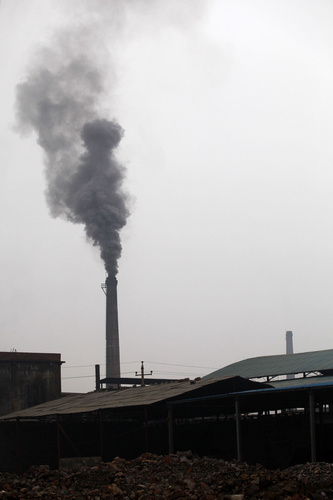
Zhuzhou, in the northeastern part of Hunan province, has been an industrial city for several decades, known for industries including non-ferrous metal smelting, chemical engineering and electric locomotive manufacturing.
While these heavy industries drove the city's economy to greater heights, the pollution got increasingly worse.
Unable to take the pollution, Xiao quit his job and moved to the downtown area and found new work in a trading company.
Xiao was not the only one troubled by the pollution. In 2003, the city government realized the severity of the problem and devised a plan to improve the environment.
"The high GDP growth generated with the pollution of environment was black GDP, and civilians were not happy with it," said Li Binong, director of the Zhuzhou environmental protection bureau.
"To clean it up, decisive action was taken in restructuring industries, and removing and eliminating polluting businesses," Li said. More than 150 companies have been relocated or closed since the country's 11th Five-Year Plan (2006-2010) period, he said.
The loss of these enterprises didn't cause the city's economy to buckle. Instead, its GDP kept an annual growth rate exceeding 13 percent, Li said.
To better monitor the environment and enhance the efficiency of green management, the local government invested 38 million yuan ($6 million) to install a digital environmental protection system in 2011. It officially started running in September.
"We built this system because still there were industrial enterprises that discharge pollutants in levels exceeding the standards, and we can't watch them around the clock," said Li.
The technology allows the city to monitor its large and medium-sized enterprises. If emissions exceed the standards, an alarm is given and a law enforcement team takes immediate action, he said.


Go to Forum >>0 Comment(s)