London's air pollution history, policies have lessons for Beijing
 0 Comment(s)
 Print
Print E-mail Xinhua, February 25, 2013


The Chinese capital Beijing recently suffered serious air pollution which gathered headlines across the world.
The problems that Beijing and Chinese cities suffer has parallels with pollution problems faced in previous decades, and still faced, in cities in developed countries.
 |
|
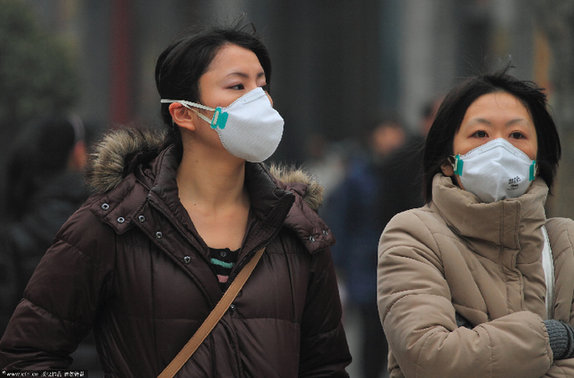
Residents wear masks when outdoors in Beijing on Feb. 24. [CFP] |
London suffered serious smog in the past and has radically changed policies as a result. It still faces public health challenges, which it seeks to tackle through promoting a better environment.
Murad Qureshi, chair of the London Assembly health and environment committee which oversees the work of the London mayor, talked about the city's history of smogs and how they led to a new approach.
Qureshi said "In 1952 we had a particularly bad few weeks of sulphur oxide pollution which literally meant Londoners were dropping dead from intense smog."
Dr Gary Fuller, senior lecturer at the Environmental Research Group in King's College, London, told Xinhua, "The 1952 smog is thought to have killed between 4 and 12,000 over just four or five days; this was a disaster."
"It was not the first smog, there had been smogs in industrial towns before in Belgium and the U.S., but the London smog is famous because of the number who died over such a short period," said Dr Fuller.
He added, "Since 1952 London's air pollution has changed, we have moved away from burning coal to heat our homes -- using natural gas -- but London still has many pollution problems. But today our problems come mainly from road transport."
But the burning of solid fuel in London in 1952 and in Beijing and its surroundings now is a similarity between the two. Lessons can be learned by Beijing from London.


Go to Forum >>0 Comment(s)