Droughts raise water supply concerns
 0 Comment(s)
 Print
Print E-mail China Daily, March 7, 2013


In Wang Lianying's backyard are four basins filled with water that she uses for laundry, one each for soaking, soaping, scrubbing and rinsing.
 |
|
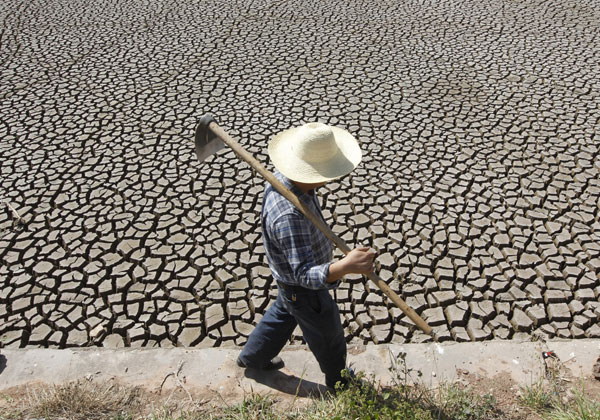
A farmer passes a dried up basin on Feb 28 in Shilin Yi Autonomous Prefecture, Kunming, the capital of Yunnan province. The lingering drought has reached 15 cities and autonomous prefectures in the province, affecting 5.58 million people. [Photo/China Daily] |
"The water's good for four or five cycles, at least half a month," the 69-year-old housewife said.
"Our ox has to drink the water we use for washing our feet.
"But we won't even be able to afford to use any water this way if the rain doesn't come in the next few days," she said.
For many villagers like Wang in Songming county, Yunnan province, conserving water is not a choice — it is an absolute necessity.
Regular droughts in winter, spring and early summer started in 2009 and have continued to affect rural and mountainous areas of Southwest China this year, reshaping the lifestyles of people and causing a major shift in the agricultural industry.
The well in Wang's yard has dropped to less than one meter deep, forcing her to walk 20 minutes a day to fetch water from a nearby reservoir, which is also in danger of drying up.
The lingering drought has hit 15 cities and autonomous prefectures in Yunnan, affecting 5.58 million people, according to the latest provincial civil affairs department statistics, and of those, 1.2 million face drinking water shortages.
This year's drought has also caused the loss of more than 557,000 hectares of crops, with 70,000 hectares of land facing complete crop failures — an estimated economic loss of up to 2.77 billion yuan ($445.4 million), authorities said.
In Songming county, many crops, such as wheat and peas, planted in mountainous areas, can be seen withered and dried out.
Ma Jixian, a 60-year-old villager, said shepherds are even being allowed to let their sheep graze in some fields planted with broad beans. "This is the only use for these crops now," he said.
The owner of the field switched from rice to broad beans last year as the irrigation source in the nearby reservoir had dried up. This year he will offer the land to farmers to cultivate vegetables in greenhouses.
Elsewhere, the agricultural shift caused by the drought is palpable: dried fishing ponds are being converted into vegetable fields, flower market gardens are also being turned over to growing simple crops.
However, at the top of the county government's agenda is ensuring a water supply for people and their livestock, especially in mountainous areas.
"In the mountains, we have to deliver the drinking water in trucks if the rain doesn't come," said Bi Jianwen, deputy director of Songming's water authority.
He added that more than 7,000 residents are facing water shortages in remote villages, which normally rely on water stores.
The government has built 763 storage ponds for households in mountainous areas this year.


Go to Forum >>0 Comment(s)