
In the second category are those who were promoted via the Communist Youth League system. After graduation, these officials started their career in the CYL. Seven officials are in this category, accounting for 9.8 percent of the total. An example is Hu Wei, vice chairman of the Xinjiang Autonomous Region whose first leadership post was county CYL secretary in Deqing, Zhejiang Province, and who was eventually promoted to the position of CYL Central Committee Secretary in 2001. In 2005, he was appointed vice chairman of Xinjiang Autonomous Region.
In the third category are those promoted from state-owned enterprises. They took up posts in state-owned enterprises after graduation, and were gradually promoted to the ranks of senior management, before switching to leading positions in government. Thirteen officials are in this group, accounting for 18.3 percent. The most typical example is Mr. Zhang Qingwei, director of the Commission of Science, Technology and Industry for National Defense (COSTIND). After his graduation in 1982, he took up aircraft design, and was eventually promoted general manager of China Aerospace Science and Technology Group. He is now chairman of the board of China's Commercial Aircraft Co. Ltd.
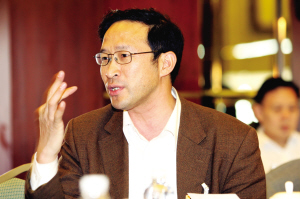 Chen Zhangliang
In the fourth category are those rising from the universities. They became teachers or researchers after graduation and were promoted to senior management posts in universities before transferring to senior government positions. Sixteen of the 71 officials fall into this category, accounting for 22.5 percent. The most typical example is Chen Zhangliang, vice chairman of the Guangxi Zhuang Autonomous Region. Chen received his doctorate in 1987 from the University of Washington and returned to teach at Peking University. In 1995 he was promoted vice president of Peking University. In 2002, he was appointed president of China Agricultural University.
Category five covers those promoted from research institutes. After graduation, this group usually started work in major scientific research institutions and were gradually promoted to management positions before switching to government positions. Seven officials, or 9.8 percent, belong to this group. A typical example is Xia Yong, director of the National Administration for the Protection of State Secrets. He graduated in 1982 and started work at the Chinese Academy of Social Sciences (CASS) as a social sciences researcher. In 2002 he was promoted director of the CASS Institute of Law, and was later appointed deputy director of the Policy Research Office of the CPC Central Committee. He was promoted to his current post in 2005.
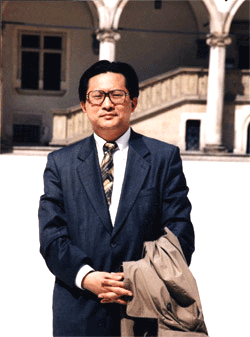 Xia Yong
The final category consists of three officials promoted respectively from the media sector, the writers association, and the People's Liberation Army.