
Hefei high-tech zone fosters high-tech industrial clusters
Updated: 2026-01-06
|China.org.cn
The Hefei National High-tech Industry Development Zone consistently drives its development by upgrading industrial capabilities and boosting innovation. By continuously optimizing its industrial ecosystem, strengthening enterprise support, and attracting more investment, the zone has improved both the quality and scale of its economy, and is steadily becoming an influential hub of high-tech industries.
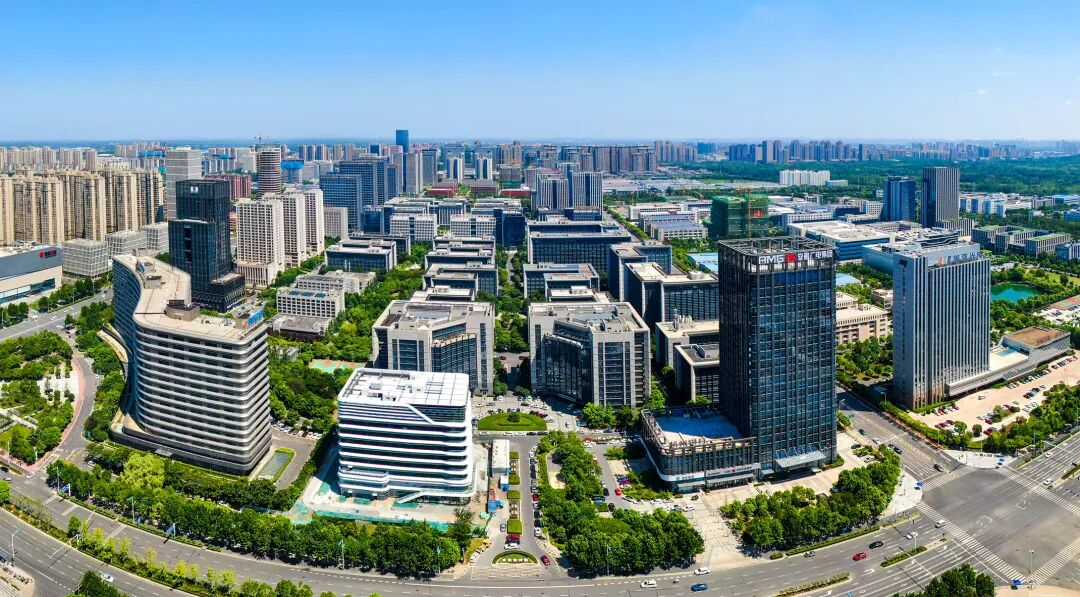
Hefei Software Park in the Hefei National High-tech Industry Development Zone. [Photo/WeChat account: hefeigaoxinfabu]
In recent years, the zone has demonstrated significant qualitative growth, with its core indicators consistently leading its peers. Its GDP increased from 110.13 billion yuan ($15.77 billion) in 2020 to 145.09 billion yuan in 2024, achieving an average annual growth rate of 6.8%, while its output per mu (0.0667 hectare) has consistently ranked first in Hefei. The enterprise cultivation ecosystem has improved progressively, and the number of market entities has doubled. Its number of national-level specialized and sophisticated "little giant" enterprises rose from four in 2020 to 135 in 2025, accounting for 17% of Anhui province's total and 43% of the provincial capital Hefei's total and forming a multi-tiered, high-growth business layout.
The advantages of industrial clusters have become increasingly prominent, and its brand influence has continuously expanded. Both the artificial intelligence (AI) and integrated circuit industries were selected as national strategic emerging industrial clusters. Additionally, the zone was approved as one of Anhui provincial future industry pilot zones with clusters of quantum technology, commercial aerospace, and general AI enterprises. This is establishing a modern industrial development pattern characterized by both emerging industries and future-oriented industries, serving as a core driving force for regional economic growth.
Looking forward, the zone aims to build a world-class high-tech park, focusing on its role as a pilot zone for industrial development, and charting a new path for high-quality development.
In terms of industrial system development, the zone will promote the upgrading of traditional industries, expand emerging industrial clusters such as new energy, electronic information, life and health, and aerospace. It will also accelerate the cultivation of cutting-edge future industries including quantum information and embodied intelligence, deepen the "AI+" development strategy, and foster deep integration between producer services and advanced manufacturing.
Regarding project services, the zone will support a pipeline of reserve projects around three major directions encompassing national strategy, industrial upgrading, and quality enhancement. This will help to optimize full-cycle tracking services from planning and construction to operation, and ensure effective project implementation. The goal is to achieve investment intensity and output efficiency comparable to world-leading standards.
The zone's investment attraction efforts have delivered outstanding results, and investment has become a key driver of high-quality development. Relying on the dual-drive strategy of scientific innovation and smart manufacturing, the zone has optimized its investment system, signing over 1,300 new projects and ranking first in Hefei. The standouts include leading enterprises and high-growth tech firms such as Cathay Biotech and Geovis Technology. Investment efficiency remains prominent. Each 100 million yuan of new investment in the zone drives 367 million yuan in output value, 391 million yuan in service revenue, and 29 million yuan in tax revenue, with multiple indicators consistently leading in Hefei.
Looking forward, the Hefei National High-tech Industry Development Zone will focus on expanding effective investment and building a pilot industrial zone. It will concentrate on promoting intelligent upgrading of investment attraction tools, enhance the precision of project attraction in future industries such as quantum technology, commercial aerospace, and AI large models, as well as implement closed-loop management throughout the project lifecycle to ensure efficient implementation. These plans are expected to help to inject continuous momentum into the zone's high-quality development.