
Hefei high-tech zone embodies China's pursuit of sci-tech self-reliance
Updated: 2026-01-08
|China.org.cn
The Hefei National High-tech Industry Development Zone, as one of the representative national high-tech zones, is steadily progressing on the path to becoming a world-class science and technology hub by deploying high-level innovation platforms, cultivating future-oriented industries, and optimizing its talent ecosystem, thereby continuously unleashing the vitality of innovation and talent.
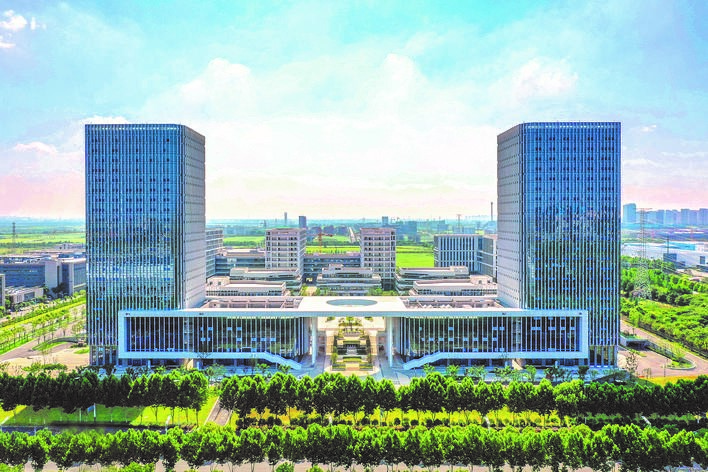
Integrated Circuit Headquarters Base in the Hefei National High-tech Industry Development Zone. [Photo/WeChat account: hefeigaoxinfabu]
The breadth of China's science and technology layout is clearly reflected in the zone. In recent years, the zone has focused on core technological fields and accelerated the aggregation of top innovation resources. It has established high-level platforms such as the CAS Key Lab of Quantum Information, USTC, and the Deep Space Exploration Lab, with the total number of provincial‑level and above R&D platforms exceeding 400.
The zone has cultivated 22 new‑type R&D institutions, six of which have been recognized as high‑level new‑type R&D institutions in Anhui province. It has also built 32 national‑level incubators, including benchmark projects such as the Zhong'an Chuanggu Incubator. Specialized industrial parks such as the Quantum Information Future Industry Science and Technology Park and the Nangang Science Park have been successively completed, providing over 6 million square meters of publicly owned space to support innovation projects throughout their lifecycle.
In terms of forward-looking positioning in future-oriented industries, the zone's efforts reflect China's determination to lead technological innovation. Currently, the zone has established three provincial‑level future industry pilot zones in quantum technology, commercial aerospace, and general artificial intelligence. The quantum information sector has gathered over 80 industrial‑chain enterprises, accounting for one‑third of the national total and incubating China's first listed quantum company. The aerospace sector has built a complete industrial chain with more than 150 enterprises. The AI industrial scale has exceeded 170 billion yuan ($24.35 billion). Looking forward, the zone will further strengthen its layout in future-oriented industries such as quantum technology, commercial aerospace, and AI large models, promote deep integration between innovation and industry, and inject strong momentum into high‑level self-reliance and sci-tech development.
Talent is the core of innovation, the foundation of development, and the primary resource driving high‑quality regional economic and social progress. The zone currently has a workforce of 587,000 people, of whom 51.1% hold a bachelor's degree or higher and 27.4% are R&D personnel. The average age of the talent pool remains around 33, reflecting a youthful and highly educated profile. Looking forward, the zone will accelerate the construction of a town for overseas study returnees to create an attractive living and working environment, making the area a preferred destination for global innovators and entrepreneurs.
From the innovation practices of the Hefei National High-tech Industry Development Zone to the nationwide wave of scientific and technological advancement, China is continuously activating innovation vitality through firm determination, systematic planning, and an open posture. On the journey toward self-reliance and strength in science and technology, such innovative examples are emerging across the country, collectively writing the Chinese chapter in the global innovation landscape.