When he heard his class was expecting a storyteller, Ben Mak, a 14-year-old student at Hong Kong's Lee Shau Kee Middle School, thought he was going to meet someone with a long beard - the type who speaks in a heavy tone and sends children to sleep.
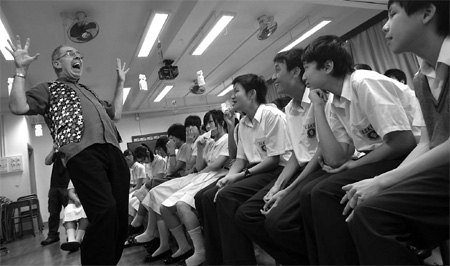
But within five minutes of Roger Jenkins' arrival, the boy felt himself being somehow lifted from his chair, as if attached to some unseen strings. Soon, he was on his toes, clapping and stomping like everyone else.
Together with Jenkins, they went on an imaginary bear hunt, during which they "went over the mountain, under the fence and through the river". The class was conducted entirely in English and was intended to be part of the school's English training program. But the pupils seemed to care less about the spelling of each word than the thrilling adventure leading to the animal's lair.
|
|
|
Storyteller Roger Jenkins entertaining students at the Hong Kong Lee Shau Kee Middle School. [China Daily] |
"Children should learn something other than the language, something they remember and value for life," says Jenkins, a Singapore-based teacher who often flies to Hong Kong to impress his wide-eyed listeners.
He once received a lesson himself when he least expected it. "I was invited to perform for a Hong Kong class and told a story about a butterfly struggling to come out of her cocoon," he says. "But the students were a bit unruly and the teacher looked all apologetic at the end of the day."
A girl of about 12 came up to him and said in a sweet and soft voice: "I like this workshop because you have just told me a story which shows how I can change my life."
Life's metamorphosis may be too abstract a theme for 10-year-old children to grasp, but Jenkins felt this was exactly what he had undergone, the cocoon being the elusive and ever-evolving art of storytelling.
"Though a voracious reader, I was extremely shy as a teenager," says Jenkins, who was sent to a boarding school in England when his father joined the British Air Force and went to Singapore in the 1960s. "Everything was fine until I reached 13 and realized there were no girls."
The only exception was the school's end-of-year theater festival, when Shakespeare was staged and girls were brought in to play the female parts. Jenkins volunteered for a supporting role, only to discover, days before the performance, that there's no girl after all.
"I was woefully disappointed," he says. "But that experience provided me with my first opportunity to stand in front of a big audience."
In retrospect, Jenkins, who was trained briefly in theater before teaching drama/poetry at schools in Britain and Singapore for a number of years, sees everything as leading up to what he was destined for.
"It took me 45 years to discover what I really wanted to do with my life," says the 56-year-old, recalling the first time he told stories professionally, in front of primary school teachers in 1998. "But the connection was instant. And with my theater background, I found it much easier to physicalize the characters, or to put on a different face or voice."
Part of that theatricality was on show, as Jenkins twisted his face into an unrecognizable blur and began speaking with a drool, in mimicry of a nerdy, goofy guy. Given that the interview took place at lunch hour inside a packed coffee house, heads naturally turned, probably to his great delight.
He has picked up other skills along the way, including drawing and paper-cutting, both of which create a curiosity factor as the complete picture is revealed at the end of the story.
Then there is magic, which renders an otherwise ordinary tale memorable. "A wow! effect - like flowers sprouting from the tip of my fingers - is always appreciated," says Jenkins, who occasionally buys new tricks from ebay for a few bucks.
"The Chinese emporium near my hotel in Hong Kong has a magic counter. Every time I'm in town, I go up there, buy some stuff and have a wonderful chat with the young magician overseeing the counter," he says.
But no encounter has proved more profound and life-changing than the one he had with a group of hearing-impaired young men many years ago. Aided by an interpreter, he told them a story about a boy who didn't flee in the face of a giant grizzly bear. Instead, the boy hit the animal on his nose and drove him away.
"But wasn't our little hero afraid when the bear roared?" asked Jenkins. "The answer is NO, because he was deaf."
"I wanted the youngsters to really laugh at their so-called disadvantage," he says.
These days, no interpreter is needed because Jenkins has acquired a sign-language vocabulary large enough for direct communication. Some of his deaf fans later became members of his Hi! Theatre, where they learned that they could not only "listen" but "tell" stories, too. The theatre has closed for some time since members have embarked on their fully-fledged career as professional storytellers/actors.
|
|
|
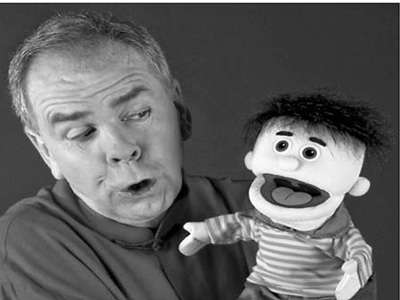
Roger Jenkins used to be a shy teenager. [courtesy of Roger Jenkins] |
"With each hearing-impaired member, we started as a duo - I narrated the story while he did the mime," says Jenkins. "Then very slowly, his gestures would become so expressive that my role was no longer essential. So I drifted further and further away, literally and metaphorically, until that person was able to perform in his own right."
Seeing his deaf students in action, Jenkins was inspired to incorporate sign language into his own storytelling, even to hearing audiences. By doing so, he has not only added a "visual" side to his performance, but also led many into the silent, but equally fascinating, world of the hearing-impaired.
Over the past decade, Jenkins has told stories to little children, whose passionate enthusiasm left a lasting impression on him, as well as adults, who, despite initial skepticism, would invariably see themselves loosen up.
His favorite story involves a tailor, who made himself a coat. Later, when the coat was over-worn, he found just enough material to make himself a waistcoat. That waistcoat then turned into a hat, a tie, and a button ...
"It's a story for the financial crisis - everybody should learn to economize and recycle. But that's not all about it," he says, pausing for effect. "When the button became worn, the tailor looked here, there, and everywhere, before he found just enough material to make a story.
"And because it's a story, it is never worn out."
(China Daily June 11, 2009)
