Fresh hope in Beijing's heritage protection struggle
 0
0 


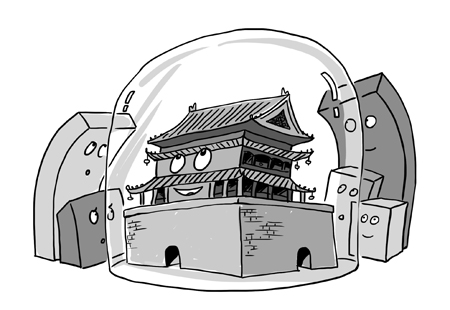 |
| [By Liu Rui/Global Times] |
The great 19th-century French poet, Charles Baudelaire, who lived through the modernization of Paris, once commented that "the form of a city, alas, changes faster than the human heart."
Baudelaire had seen Paris' traditional neighborhoods knocked down and replaced with wide boulevards, large squares and huge building projects such as the Louvre, which would go on to become some of the city's most iconic structures.
In the process, tens of thousands of people were evicted. The city authorities were accused of cultural degradation, of driving ordinary people out of the city center and of favoring powerful property developers over local residents.
As the example neatly demonstrates, urban redevelopment and management of the built environment is a highly complex task driven by diverse and, at times, conflicting forces.
A century and a half later in Beijing, another city undergoing rapid change, we are seeing many of these same tensions play out in real time.
Striking a balance between these competing interests is no mean feat: How to deliver the benefits of modernization without destroying traditions? How to find an appropriate and sustainable role for the markets in conservation? How to protect the rights of local residents while stimulating local development? Each of these is an enormous challenge in itself, and this list is far from exhaustive.
Nowhere has this struggle been more evident than in Beijing, where the tragedy has been two-fold. Not only have many historic buildings been lost, but they have generally been replaced with bland, unimaginative developments which contribute little to the urban landscape.
However, there are signs that the tide may be changing.
The days of widespread hutong (traditional alleyways) destruction seem to be over. The emergence of popular locations such as Nanluoguxiang and Fangjia Hutong, two shopping and bar streets located in traditional Beijing alleyways, have demonstrated alternative ways of deriving value from the city's historic neighborhoods.


Go to Forum >>0 Comments