A drain on the nation
- By Jonathan Jones
 0 Comment(s)
 Print
Print E-mail
China.org.cn, June 28, 2011
E-mail
China.org.cn, June 28, 2011


|
|
|
Rainstorms pounded the Chinese capital Thursday afternoon. The storms delayed over 140 flights, slowed road traffic and disrupted the operation of two subway lines in the afternoon rush hours. [Photo/Xinhua] |
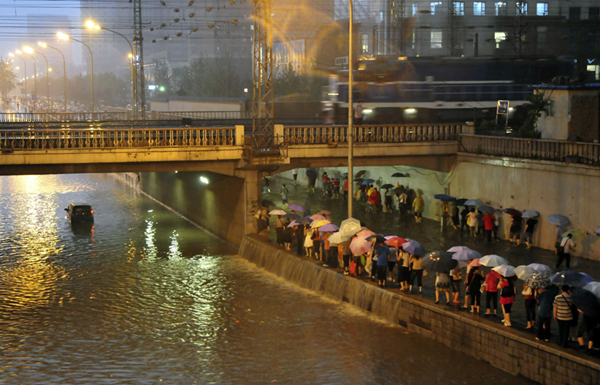
Summer thunderstorms in Beijing are an annual occurrence, but the deluge that hit the capital last Thursday took many by surprise. It was reported that over six inches fell in an hour in some districts, flooding many roads and cascading down into subway stations.
Commuters were left to find alternative ways home as bus routes were cancelled, trains were delayed and taxi drivers retired early for the night. International travelers were hit even harder as 97 flights were cancelled at Beijing Capital International Airport.
The chaos was stoically met by most local commuters, but they are entitled to ask why the drainage system failed in such a short span of time.
A statement on the subway website said that Line No.1 had been closed because water was coming in quicker than their three high-power pumps could drain. Their clarity was appreciated and besides, anyone in the vicinity could see the problem needed to be tackled at ground level before it reached the subterranean levels.
Cities such as Beijing have grown at an incredible rate in recent years which has meant resources have understandably been directed at keeping pace with the growth rather than replacing and updating old and outdated drains or pipework. The recent torrential rain has shown this needs to change.
You have to have some sympathy with officials who could not have known such a torrential downpour was on its way and they did respond with extra manpower. Police officers were drafted in to help with the resulting traffic congestion and to keep pedestrians away from the flash flood areas.
However these types of reactionary measures can only do so much. Procedures, communication channels and above all an effective drainage system need to be in place prior to such an event happening.
Make no mistake, this is not an easy task to accomplish. Weather does not conform to what is expected so no-one can say with certainty that they are fully prepared for any situation, but one sure way of ensuring failure is to rely solely on historic data to formulate plans.
Basing procedures on previous patterns is a universal management technique. It is used in commercial, financial, military and civilian projects the world over. It is a solid basis on which to plan but it is flawed unless one also accepts the unpredictability of the future.
The financial crisis of 2008 and the nuclear scare in Fukushima, triggered by March's earthquake and subsequent tsunami, are examples of what can go wrong when planners believe the very worse that can happen is a repeat of a past event.
Without a built in flexibility, systems become overloaded once that previous level is breached. Much of the pipework under Beijing is over fifty years old and was constructed based on the needs of the time so is now obviously in need of an overhaul.
In this case though, the adoption of new procedures and subsequent feeding of the communication network are made all the more complex by the various ministries, provincial and local governments who are charged with water-related issues. With such overlapping it is difficult to determine who controls the planning and co-ordination of the overall strategic framework.
It may seem churlish to concentrate on major cities who have had to cope with ineffectual drains when a total of thirteen provinces have been battling against floods that have claimed the lives of at least 178 people, but ultimately the issues are linked.
The harm caused by rainfall cannot be underestimated but neither should we ignore the fact that China has limited useable water resources. If a way could be found to protect citizens from the horrors of flooding and to collect the surplus water for future use, a potential catastrophe could be turned to the country's advantage.
With the global environment under threat and future surges in weather phenomena increasingly likely, a larger slice of China's booming economy should be directed at improving the nation's ability to respond to such emergencies.
Without such commitment and focus, people in the central farmlands and in the glistening tower blocks on the east coast will continue to be at the mercy of nature's onslaught.
The author is a communications professional, film maker and published writer with a keen interest in life.
Opinion articles reflect the views of their authors, not necessarily those of China.org.cn.


Go to Forum >>0 Comment(s)