Warning Chinese buyers against taking US house-for-visa bait
 0 Comment(s)
 Print
Print E-mail
Shanghai Daily, November 28, 2011
E-mail
Shanghai Daily, November 28, 2011


 |
|
By Zhou Tao/Shanghai Daily |
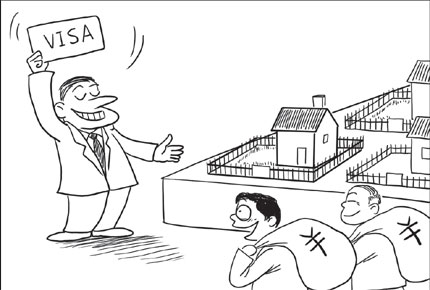
The proposed legislation, formally called the Visa Improvements to Stimulate International Tourism to the United States of America, or VISIT-USA Act, offers a three-year renewable visa for foreigners who invest US$500,000 or more in residential real estate, at least US$250,000 of which must go toward a primary residence.
The visa holders, meanwhile, must live in their primary residence for at least 180 days a year, and pay US income taxes on their foreign earnings. They won't be eligible for Medicare, Medicaid, or Social Security benefits. Their visas wouldn't serve as a pathway to US citizenship or as an authorization to work. A property sale would render the visa invalid.
Republican Senator Mike Lee from Utah claimed that the bill would support a free-market method for increasing demand for housing at a time when so many working-class Americans are "underwater" on their homes and are desperate for prices to rise again.
While that might be true, I hear myself ask the same question as Mr Reich - what about those young Americans who are just entering the market and would prefer low home prices that aren't bid upward by rich foreigners?
And what about fairness? Many foreclosures took place because low-doc or no-doc speculators applied for loans they knew they didn't have the means to service, hoping to refinance or sell the homes after they appreciated. All they had to do to acquire a loan was to put down a false income on their applications. Is it fair to artificially inflate home prices then, at the expense of the more honest, prudent Americans whose integrity probably went above the urge to jump on the "liar loans" bandwagon?
Democratic Senator Charles Schumer from New York believed that the bill could be part of the solution to the housing crisis and won't cost the US government a nickel. What it might do to further drain the Chinese government coffers was obviously something the Americans need not be concerned about.
But unlike the Chinese government, which has been ratcheting up state intervention in its protracted war against speculative buying in the mainland property market, the US government was uncharacteristically slow to respond to the obvious signs of a potential housing meltdown in the sub-prime mortgage crisis, until things spun completely out of control.


Go to Forum >>0 Comment(s)