'Shockwave' leeks new front in battle against inflation
 0 Comment(s)
 Print
Print E-mail Shanghai Daily, March 30, 2012


There have been a string of reports lately about the soaring price of leeks.
|
|
|
[By Zhou Tao/Shanghai Daily] |
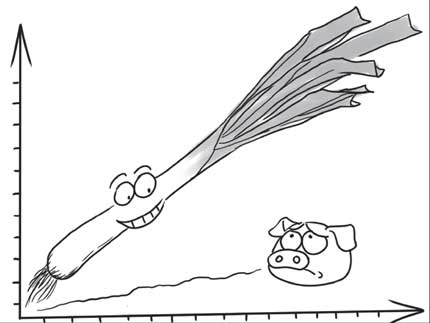
The vegetable, a staple in northern Chinese cuisine, has generally more than tripled in price in many locales. In cities like Shanghai and Beijing, two leeks can now sell for 10 yuan (US$1.47), almost as expensive as pork and poultry, whereas not long ago the same amount of money could buy several jin, or 500 grams, of the vegetable.
The dramatic price increase has given rise to a popular new buzzword both online and in print media, cong ji bo, which bears the character for leek and is phonetically similar to the Chinese for shockwave.
Shrinking supply is mainly to blame for this sudden price hike. It is reported that in Zhangqiu City, Shandong Province, a major grower of leeks, the yield this year has dropped almost by half, due to bad weather and lack of incentives for leek farmers.
Low prices of leeks have dampened interest in growing them. After sustaining heavy losses for two years, many farmers decided to opt for more lucrative crops.
The shortfall in supply has to be filled by leeks transported from as far south as Shanghai and Fujian Province, where the pungent greens are planted on a large scale but local demand is low.
The long journey has further raised their price, with rising fuel costs, road tolls and other logistics fees trickling down to end consumers.
As with price hikes that hit daily necessities such as garlic bulbs, mung beans, ginger and sugar in the not too distant past, many are now accusing intermediate leek traders of profiteering and greedy pricing.
Given past observations, such accusations are often well-grounded. But leek dealers are pleading innocence, claiming they are not engaged in price gouging.
A reporter with Shandong Business News recently tracked locally grown leeks all the way from farms to wet markets. The investigation revealed that throughout the trip, a leek changed hands at least five times before it reached the table.
It basically works like this: A dealer buys from a leek farmer at a fixed price, and resells the purchase to a bigger dealer, who in turn sells it to a wholesaler, who ships the greens finally to a retailer.
'Reasonable markups'
Every step of the way, there are numerous new costs added to the price, including aforementioned transport costs, labor costs for bundling, packaging and sprucing up the leeks, stall fees at wet markets and other expenses and taxes.
All of the additional costs result in a much higher price than what little money the farmer is paid for his harvests. Typically, Leeks are bought at 0.7 yuan per jin on farms and can fetch 3 yuan in the market, the newspaper reported on Wednesday.
However, intermediate traders quoted in the report said they sold the vegetable at reasonable markups, some as little as 2 fen, the smallest unit of Chinese currency, and every penny they earned could be justified. Besides, they argued that in bad times they could lose money if prices plummet.
Maybe individual traders are not solely responsible for the exorbitant prices, but their self-justifications cannot mask the basic fact, that is, if they turn a profit, it has nothing to do with the very people who grow the leeks. And the costs of their convoluted transactions are ultimately borne by consumers.
Although perishables like leeks are not ideal for speculation, there indeed are those who bought and resold a large quantity of the vegetable and made an outrageous fortune out of it, to the tune of millions of yuan, according to a report published by the Oriental Morning Post on March 19.
It may be hard to categorize these profits as illegal, but the trading practices that cause gross price distortions in a necessity consumed by millions should be curbed.
The question is, what can be done to streamline the expensive intermediate trade?


Go to Forum >>0 Comment(s)