Mo's win highlights global literary fusion
 0 Comment(s)
 Print
Print E-mail China.org.cn, October 12, 2012


The Chinese public gave out a collective sigh of relief when the Swedish Academy announced on Thursday that it had awarded the 2012 Nobel Prize for Literature to Chinese writer Mo Yan who "with hallucinatory realism merges folk tales, history and the contemporary."
 |
|
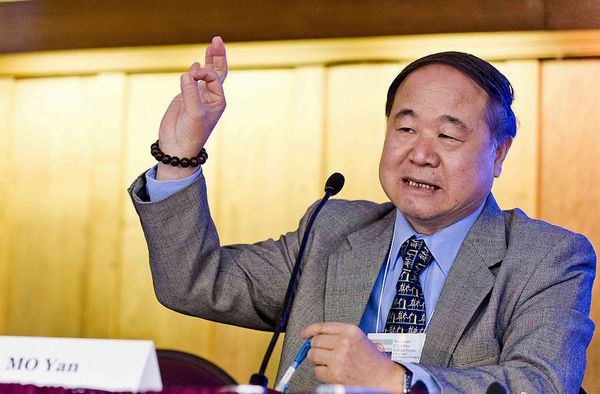
Chinese writer Mo Yan [File Photo] |
This long-awaited result made headlines in the Chinese media amid the country and its people's increasingly stronger wish to go global and integrate into the world.
The event, like the Olympics and the World Expo were before, is again a dialogue between China and the world. However, the longing for the prize represents a more complicated national anxiety, as it has been recognized that China's rise should be backed by the independence and creativity of the nation's individuals, in addition to a stronger national power. It seems that this anxiety is widespread as the topic "Will a Chinese person become the laureate of the Nobel Prize in Literature?" remained the most popular one online, with many Chinese netizens worried that Chinese writers might miss out on the top prize again.
This landmark in China's literary history has also invoked great reflection on why Mo could become the very first Chinese writer to win the prestigious prize, especially against the prize's history of mainly bearing a Europeanized trait.
When we look back on the history of contemporary Chinese literature, we can see that Mo's maturity in literary creation is deeply rooted in the more open social environment of the 1980s, when China was embracing a Chinese-style Renaissance with plenty of Western academic and literary works entered the country, paving the way for more modern or even post-modern forms of literary creation. Mo greatly benefited from this golden era, which bridged the communication and exchanges between Chinese and Western writers. Mo, a root-seeking writer well-versed in portraying his complex emotions of love and hatred for his hometown, became successful for adapting his vision to an even broader social environment. That's why his root-seeking works were critically acclaimed as "hallucinatory realism." We see in Mo's works the influences of Gabriel García Márquez and William Faulkner, with his fantastic imagination inspired by the former and the critical style derived from the latter.
It's in this open environment for dynamic thinking that Mo, as well as many other renowned Chinese writers – including Yu Hua, Ge Fei, Ma Yuan, Beidao, Haizi and Gu Cheng – emerged and began their experimental and progressive literary creation.
These avant-garde writers, with Mo as their representative, broke with China's literary tradition which had dominated the field for several thousands of years. They shook off the rigid conventional rule that writings are for conveying the truth, and turned writing into a medium that could shed light on one's aspirations and thus portrayed a more humanistic concern for individuals and their reflections on the fundamental nature of being and the world they live in.
"Mo Yan's works write about his deep affection for his hometown and his fundamental concern about the local folk culture," said the committee when presenting Mo with a prize for his outstanding achievements at the award ceremony for the 2008 Chinese Literature Awards. Indeed, in addition to showing his care for his birth province, Mo also highlights the importance of personalization in writing by focusing on a "life with distinctive and spectacular characteristics." Consequently, it's clear that Mo's success lies in his merging of reality with history, the individual with society and, most importantly, China with the world. The congratulatory letter to Mo from the Chinese Writers Association reads: "Chinese writer Mo Yan's winning the Nobel Prize in Literature this year implies what Chinese literature means to the world."
In conclusion, Mo's success can be attributed to the exchanges between and integration of different cultures and thoughts while at the same time maintaining their unique traits. This is what all Chinese writers can do to take Chinese literature to the next level.
(This article was a Nandu Daily editorial and translated by Zhang Junmian.)
Opinion articles reflect the views of their authors, not necessarily those of China.org.cn.


Go to Forum >>0 Comment(s)