Pentagon power games
- By Zhao Jinglun
 0 Comment(s)
 Print
Print E-mail China.org.cn, May 9, 2013


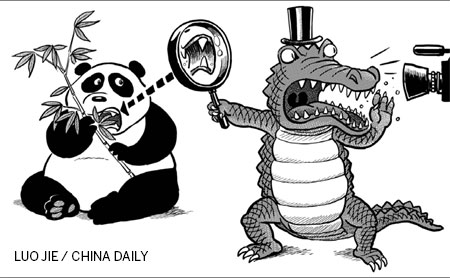
The Pentagon, which controls unquestionably the world's most powerful military, wrote in somewhat hysterical terms about "China's military threat" in its recent report issued on May 6. It would be comical if the matter was not so serious. But what possessed the U.S. Department of Defense (DOD) to write in such terms? The answer lies in the politics of necessity: Washington spends nearly $700 billion a year on "defense" to feed its gigantic war machine and it needs an adversary, even a potential one.
Pursuant to the National Defense authorization act for fiscal year 2000 passed by the U.S. Congress, the DOD issued annual reports on the Chinese military for the past dozen years. This year's report, though, is twice the size of the one produced last year.
It is unusual that the report devotes an entire paragraph to the issue of the Diaoyu Islands, which it prefers to call "Senkaku," thereby clearly favoring Japan. In spite of its obligation to respect the Potsdam Proclamation and the Cairo Declaration requiring defeated Japan to return all seized territories, Washington chose unequivocally to back Japan in its illegal claim to those islands which should have been returned to China long ago.
Why has China's determination to defend its territorial integrity touched a nerve in Washington? Why is the DOD getting so carried away when China is only developing its normal defense capabilities? The U.S. is, by comparison, developing sophisticated weapons systems such as the X51A that can strike any target any where in the world within an hour. Who exactly is threatening whom?
The United States has always regarded the Pacific as its exclusive domain. It is used to a weak and submissive China and finds China's rise worrisome, even though that rise is peaceful and it is clear that China has no wish to challenge U.S. hegemony.
The report talks about China's strategy: Anti access/area denial (A2/AD); but this is a Western construct. It does note that some PLA strategists call it "counter-intervention operations," more precisely "Active Strategic Counterattacks on Exterior Lines." China has always emphasized the defensive nature of its strategy.
An active defense strategy incorporates long-range strike forces and sea and air capabilities. For nuclear deterrence, China has developed ICBMs capable of carrying a multiple independently targetable re-entry vehicle (MIRV), and also DF21D anti-ship ballistic missiles (ASBM) capable of attacking large ships, including aircraft carriers.
With these capabilities, China has been able to break through the first island chain designed by the U.S. to fence China in and send blue-water naval forces to exercise in the West Pacific.
That is all part of a defensive strategy. China has not occupied an inch of foreign territory and maintains no foreign military bases. In addition, China has not started a war against any country since the Ming Dynasty, when it possessed huge flotilla of ocean-going ships.
The Pentagon wildly exaggerates China's military capabilities and these exaggerations sometimes rely on a combination of heresy and guesswork. It is offensive, too, that despite vastly improved relations between Beijing and Taipei, Washington has tried to stir up discord in order to sell weapons to Taiwan.
Two days before the DOD made its report public, the Carnegie Endowment for International Peace published its own report, "China's Military and the U.S.-Japan Alliance in 2030: A Strategic Net Assessment". This report adopts a much calmer and more moderate tone. One of its major findings is that "the most likely potential challenge to the U.S.-Japan alliance over the next fifteen to twenty years does not involve full-scale military conflict between China and Japan or the United States." No full-scale military threat after all, then. There's hope yet.
The author is a columnist with China.org.cn. For more information please visit: http://www.china.org.cn/opinion/zhaojinglun.htm
Opinion articles reflect the views of their authors, not necessarily those of China.org.cn.


Go to Forum >>0 Comment(s)