Anatomy of an electoral defeat
- By Heiko Khoo
 0 Comment(s)
 Print
Print E-mail China.org.cn, May 14, 2013


Pakistan's election resulted in victory for Nawaz Sharif's Pakistan Muslim League (PML-N) and defeat for the Pakistan People's Party (PPP) under President Asif Zardari. The PPP government was the first full-term government since independence; previous governments were either overthrown by the military or dissolved by the incumbent President.
Before 1939, the Indian sub-continent was the crown jewel of the British Empire. India's national independence movement grew during the World War II. The imprisonment of its leaders and the starvation of millions in Bengal generated a powerful anti-colonial revolution that could have created a united socialist India.
|
|
|
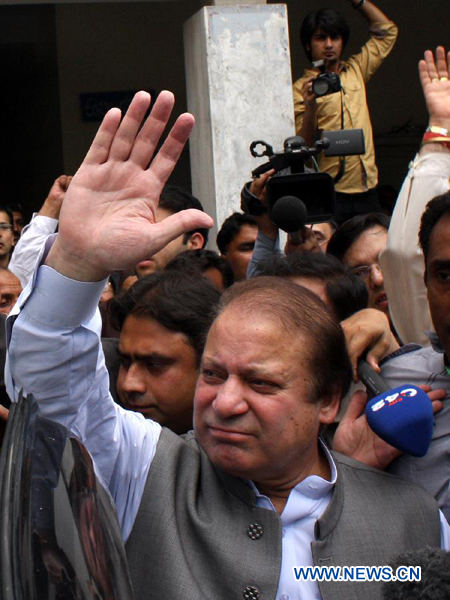
FormerPakistani Prime Minister Nawaz Sharif (Front) waves to supporters as he arrives to cast his vote in eastern Pakistan's Lahore, May 11, 2013. [Xinhua] |
Muhammad Ali Jinnah was a British trained constitutionalist whose Muslim credentials were instrumentalist rather than fundamentalist. His Muslim League collaborated with the British. It claimed to be "protecting" Muslim interests but, in reality, it mainly represented the interests of local feudal landowners. The birth of a decolonized India simultaneously divided it on religious lines. This produced a bloodbath. The communal riots that accompanied partition led to a terrible loss of life as Muslim refugees fled to Pakistan in the northeast and northwest and Hindus fled to the new India.
Many leaders of newly independent former colonies hoped they might industrialize and modernize their countries, but the combination of landowners, religious powers, military reactionaries and imperialist influence meant that national capitalists were a weak political force. They were incapable of carrying out a stable, democratic-capitalist transformation of society – largely because their opposition to the old order was tempered by their fear of the insurgent discontent of the rural poor and the working class.
Therefore, elite landowning factions, known in Pakistan as "the feudals," collaborated with the military to control the country. To this day, the Pakistani military controls vast swathes of the economy and society.
Ayub Khan, backed by the United States, installed Pakistan's first military dictatorship from 1958-1969. Zulfikar Ali Bhutto, a self-proclaimed socialist, had been his foreign minister. In 1967 he founded the Pakistan People's Party (PPP), a party whose founding documents called for the overthrow of capitalism and landlordism and the creation of a socialist state.
A mass revolt over socio-economic issues gripped Pakistan in 1968-9. Zulfikar Ali Bhutto supported it and was arrested. This revolutionary maelstrom generated the mass support base of the PPP. The revolutionary movement forced Ayub Khan to resign. As state power crumbled, support grew for the PPP. Another short-lived military regime headed by General Yahya Khan replaced him, but reflecting the changed societal mood, Khan carried out some positive reforms and spoke of socialist change.
The PPP won elections in West Pakistan in 1970. But after losing a war with India, a civil war in East Pakistan led to the formation of an independent Bangladesh. Bhutto became President of the remaining (west) Pakistani state in December 1971 and was Prime Minister from 1973-1977.
Although the PPP drew its support from the mass of the poor and oppressed, it was also influenced by powerful feudal forces. The Bhutto family itself owns huge tracts of land. Nevertheless, Zulfikar Ali Bhutto carried out some radical reforms including land reform, and nationalization of the banks and some important industries. But there was no revolution in state power, so landowners, capitalists and the military continued to wield enormous influence and conspired to orchestrate the American-backed coup d'état which brought General Zia-ul-Haq's brutal regime to power in 1977. Zulfikar Ali Bhutto was arrested and executed.
In neighboring Afghanistan in 1978, left-wing military officers backed the People's Democratic Party of Afghanistan and took power. They instituted a program of revolutionary change, which provoked a ferocious reaction on the part of landowners and tribal Islamists. The Afghan government dragged the Soviet Union into a war against these insurgents. Soviet intervention justified Zia-ul-Haq's promotion of radical Islam in the Pakistani army and state. They provided support to Mujahedeen fighters (including Osama Bin Laden) in their war against "communist infidels." Saudi finance and vast logistical support from the United States and Britain inflamed the conflict. At that time, U.S. President Ronald Reagan and U.K. Prime Minister Margaret Thatcher considered Osama Bin Laden and his friends to be "freedom fighters." The Soviets only withdrew in 1989.
The PPP won elections in 1988 and Benazir Bhutto, the daughter of Zulfikar Ali Bhutto, became the Prime Minister. But the PPP government was dismissed after only two years in office and Navaz Sharif won new elections in 1990. Either Sharif or Benazir Bhutto held the post of Prime Minister for most of the time from 1988 until 1999. Sharif privatized, whereas Bhutto generally tried to maintain state-owned enterprises. In truth, both Bhutto and Sharif's governments were both mired in corruption scandals.
The power of the elites was left intact as Benazir Bhutto failed to challenge the entrenched interests of the landowners and the military. Pervez Musharraf seized power in an American-backed military coup in 1999. He was considered to be a staunch ally in the "war on terror" but the Pakistani military continued to play a double game when fighting the "terrorists." Benazir Bhutto returned from exile in 2007, and on October 17 the same year, she survived a suicide bomb attack that killed 136 of her supporters. She was later assassinated by persons unknown on December 27.
Asif Zardari, Benazir Bhutto's former husband, formed a PPP-led coalition government in 2008, which lost the recent election. Widespread corruption, the failure to resolve electricity supply shortages or to radically transform the division of wealth and power relations in Pakistan, are the main reasons why the PPP lost these elections. The Bhutto family treats the entire PPP machine as their personal property. This is not in tune with the times. If the PPP is to rebuild its mass base it must reconnect with its historical genesis as a socialist party.
Unity of the working class in fighting organizations will be essential in the battle against poverty and austerity. The PPP will need to firmly entrench democratic methods of discussion, debate and participation into its everyday political practice under the control of party members. Its demands must focus on meeting the basic needs of the masses including securing food, shelter, education, healthcare and infrastructure projects to protect people against floods like those which hit in 2010, and it must also create a modern state. By doing so, it could reconnect the Pakistani masses and their everyday struggles with their brothers and sisters throughout the Indian sub-continent.
The author is a columnist with China.org.cn. For more information please visit:
http://china.org.cn/opinion/heikokhoo.htm
Opinion articles reflect the views of their authors, not necessarily those of China.org.cn.


Go to Forum >>0 Comment(s)