Abe's uneasy alliance
- By Zhao Jinglun
 0 Comment(s)
 Print
Print E-mail China.org.cn, May 15, 2013


Shinzo Abe was not happy about being labeled a "strong nationalist" by the U.S. Congressional Research Service (CRS) in a report on Japan-U.S. Relations issued on May 1. The label is accurate, if somewhat charitable. The term "rabid militarist" may be more on the money.
CRS was worried that "comments and actions on controversial historical issues by Prime Minister Abe and his cabinet have raised concerns that Tokyo could upset regional relations in ways that hurt U.S. interests."
Yet in discussing the "Senkaku/Diaoyu territorial dispute with China," the 33-page CRS report reiterated Washington's biased position and even echoed Japan's groundless accusation that a Chinese naval ship locked its weapons-targeting radar on Japanese assets, while failing to make clear that the incident was actually a result of Japanese provocation.
|
|
|
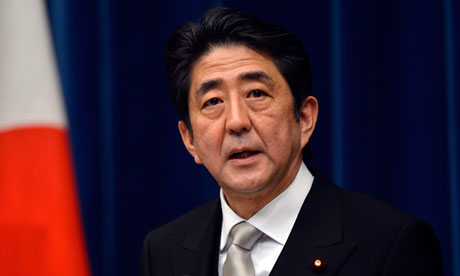
Shinzo Abe[File photo] |
The report noted that Abe and his ultra-nationalist cabinet members question the apologies made by Yohei Kono (1993) and Tomiichi Murayama (1995), and that they have attempted to reword or even replace them with new statements that would whitewash Japan's war crimes.
It also mentioned Japan's apology to the U.S. on the wartime treatment of U.S. prisoners. It noted that according to various estimates, approximately 40 percent of prisoners held in Japanese camps died in captivity, compared to 1-3 percent of the U.S. prisoners held in Nazi Germany's POW camps. Thousands more died in transit to the camps, most notoriously in the 1942 "Bataan Death March," in which the Imperial Japanese military force-marched almost 80,000 starving, sick and injured Filipino and U.S. troops over 60 miles to prison camps in the Philippines. The march killed 18,000-20,000 prisoners.
Yet, in spite of Japanese brutalities, the report states that: "Japan is a significant partner for the United States in a number of foreign policy areas, particularly in terms of security priorities from hedging against Chinese military modernization to countering threats from North Korea."
But there remains the prominent controversy over the relocation of a Marine Corps base in Okinawa. The 2006 agreement between U.S. and Japan to relocate the Futenma Marine Corps Air Station from its current location in crowded Ginowan City to Camp Schwab, in a less congested part of the island, was envisioned as the centerpiece of a planned realignment of U.S. forces in Japan. Under the agreement, the U.S. would redeploy 8,000 marines from Okinawa to Guam in exchange for permission to construct a new Marine Corps facility at Camp Schwab. But the plan faces strong opposition by figures on both sides and a workable solution remains elusive.
More fundamentally, two scholars from the Chinese Academy of Social Sciences wrote an article in which they raised the question of sovereignty over the Rhukyu chain. Okinawa is the biggest of the Rhukyu Islands, which stretch for about 1,000 kilometers from Japan's mainland and were the center of the Ryukuan kingdom, which paid tribute to Chinese emperors and was a "vassal state of China" until it was annexed by Japan in 1879.
According to the Cairo Declaration and Potsdam Proclamation, defeated Japan should have returned all territories it had seized, including the Rhukyu chain. Japan's obligation is not to return the Rhukyu chain to China, but to the Rhukyu people as an independent state. The people there don't even speak Japanese and visitors find that those islands are very different indeed from Japan.
In Okinawa, all major political figures oppose the Futenma Base relocation plan. The deployment of the MV-22 Osprey tilt-rotor aircraft to the Futenma base in the summer of 2012 faced particularly severe opposition from local residents. A series of crimes committed by U.S. service personnel further inflamed resentment among locals who want U.S. forces to leave the island. The CRS report recognizes this, saying: "The grievances that the Okinawans have harbored for decades seem unlikely to fade."
The author is a columnist with China.org.cn. For more information please visit:
http://www.china.org.cn/opinion/zhaojinglun.htm
Opinion articles reflect the views of their authors, not necessarily those of China.org.cn.


Go to Forum >>0 Comment(s)