Kept in the loop
- By Gong Wen
 0 Comment(s)
 Print
Print E-mail China.org.cn, May 19, 2013


|
 |
|
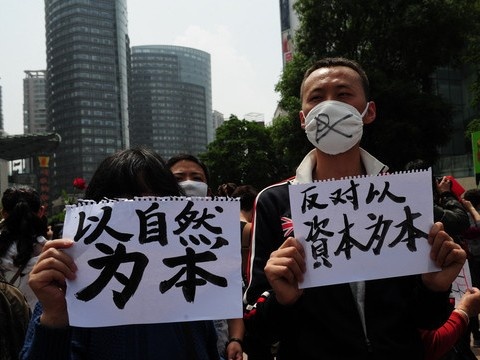
Kunming citizens launch protests against the building of chemical plants in May 2013. |
From Shifang, Qidong and Zhaihai in 2012 to Chengdu and Kunming in 2013, environmentally-motivated "NIMBY"(not in my backyard)protests against the building of chemical plants have spread rapidly across many Chinese cities in recent years. According to statistics published by the Ministry of Environmental Protection, there has been a 29 percent average annual increase in such events since 1996. Rising NIMBY protests bring with the greater social disquiet and occasionally severe public crises.
In his book Responding to Community Outrage: Strategies for Effective Risk Communication, Peter M. Sandman, a prestigious scholar in the field of risk communication, proposed the equation "Risk = Hazard + Outrage" to define what risk is. Here, outrage refers to what the public understands by risk and all the things that people are worried about that the experts ignore. It seems that the residents of some Chinese cities have become more easily "outraged" in recent years as many new schemes are proposed. Despite the claims of experts, local governments and relevant factories that the project utilizes the most advanced technology and will not negatively impact on the local environment, or that it conforms to national standards of environmental protection and has passed the Environmental Impact Assessment (EIA) by Ministry of Environmental Protection, citizens still worry about the risks associated with nearby chemical plants, and some take extreme measures. In fact, government assertions regard risks are quite different from what the public's understanding of the issue.
So what causes the public to distrust both the government and experts? Why do people become so outraged?
The World Health Organization (WHO) defines risk communication as "an interactive process of exchange of information and opinion on risk among interested parties, in which, ideally, all stakeholder groups should be involved from the start." Therefore, risk communication is governed by two overriding precepts: First, it should be the two-way exchange of information between government and the public rather than a bureaucratic one-man show; and second, all stakeholders should take part in the whole process of risk assessment, through which mutual trust and consensus can be built.
However, during most Chinese NIMBY events, the two basic rules of risk communication are ignored. Local governments rarely consult with or listen to the public and even intentionally neglect opposition voices among the public because economic development and chasing higher GDP numbers come top of the government's agenda. In many cases, public consultation procedures such as Hearing or EIA, in which the public should fully participate, are manipulated, which interferes with the public's right to know. Take the Kunming refinery project protest which happened during the May Day Holiday as an example. An online survey conducted by the Yunnan Info Daily indicates that nearly 60 percent of citizens say they don't know much about the project.
So, risk communication, which should have been an integral part of the communication chain, is reduced to a final public notification that a chemical plant will be constructed, along with official assertions that it will not harm the local environment and will boost local economic development! The absence of two-way risk communication and the lack of public participation intensifies the feeling among the public that the authorities cannot be trusted, which in turn intensifies negative perceptions of the planned projects.
The above mentioned survey also showed that nearly 70 percent of respondents claim they don't believe the evaluations made by the government and experts. Such distrust is dangerous and it often leads to public outrage, which has the potential to increase social risk and even escalate into the kinds of public crises witnessed last year in Shifang and Qidong.
These displays of outrage occur when people are excluded from the process of decision making which concerns matters which relate to their interests. People become outraged because they don't think government provides open and fair information.
In light of all these there are three main things the government should do to reduce the risk of future NIMBY protests.
First, risk communication should be included throughout the whole decision making process. Instead of telling the public not to worry about the potential risks posed by a chemical plant at the final stage of its construction, the government ought to exchange information with the public before, during and after decision making, trying to reach a consensus through which mutual trust can be built.
Second, information disclosure must be strictly enforced to make sure the public has sufficient information to help them decide. An open and quick responsive government is infinitely preferable to an opaque and slow one.
Third, the role of the media is crucial. As a key component of social communication, the media should bear its responsibility as a social guardian without diminishing or exaggerating any risks it uncovers with projects. Meanwhile, new media such as microblogs and SNS provide a good interactive platform for both the government and public.
Ulrich Beck has argued that we are living on the volcanic vent in the age of the "risk society". Things are more complicated in China with the country going through both a social and economic transition during which various risks are mushrooming. Therefore, efficient risk communication is of great importance, without which a harmonious society cannot be realized.
The author is a doctor candidate at the School of Journalism and Communication at Tsinghua University.
Opinion articles reflect the views of their authors, not necessarily those of China.org.cn.


Go to Forum >>0 Comment(s)