A snapshot of Hunan
 0 Comments


Hunan Province is located in the middle reaches of the Yangtze River in central China, with its neighboring provinces Jiangxi, Chongqing, Guizhou, Guangdong, Guangxi and Hubei. The distance of Hunan from east to west is 667 kilometers, while 774 kilometers from north to south and the total area is 211,800 square kilometers. Because most of the province is located south of the Dongting Lake, it is named "Hunan;" and because of the Xiangjiang River, the longest in the province, its shortened name is called“Xiang”.
Hunan has a humid continental and subtropical monsoon climate with distinctive four seasons, sufficient sunshine, long frost-free period and abundant rainfall. It has an average annual sunshine of 1,300-1,800 hours, annual average temperature of 16°C-18°C, and a mean annual precipitation of 1,200-1,700 mm. It is suitable for human living and growth of crops and green plants.
Hunan has a huge river system with the Dongting Lake, the No.2 freshwater lake in China, in the north. The Xiangjiang River, the Zijiang River, the Yuanshui River, and the Lishui River flow into the Dongting Lake from the southwest to northeast, connecting with the Yangtze River. The total quantity of natural water resources in Hunan is on the top of nine provinces in South China.
Hunan is famous for its "home to nonferrous metal and nonmetal mineral." Out of the more than 160 plus mineral categories discovered in the world, Hunan has 141, among which the remaining deposits of 41 minerals, such as Stibium, Tungsten and Manganese stand among the top five of China.
Hunan has rich resources of animals and plants with a wide coverage. Five rare surviving "living fossil" in the world are founded in Hunan, namely: Cathaya Aargyrophylla, Met sequoia Glyptostroboides, Glyptostrobus Pensilis, Gingko and Davidia Involucrate.
|
|
|
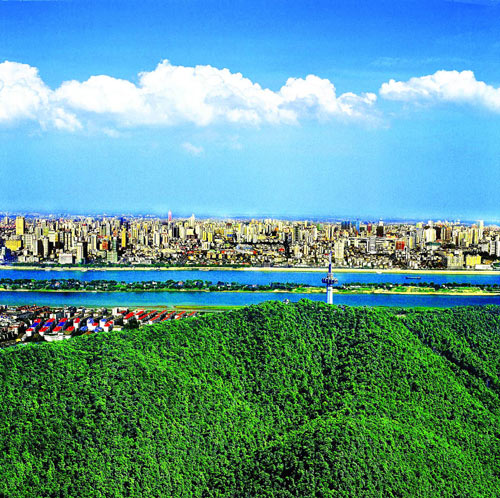
The photo shows the beautiful scenery of Hunan, China. [China.org.cn] |


Comments