Authentic to the end?
- by Zhang Zixuan
 0 Comment(s)
 Print
Print E-mail
China Daily, November 15, 2011
E-mail
China Daily, November 15, 2011


|
|
|
A panoramic view of the World Heritage site, Pingyao old town. Provided to China Daily |
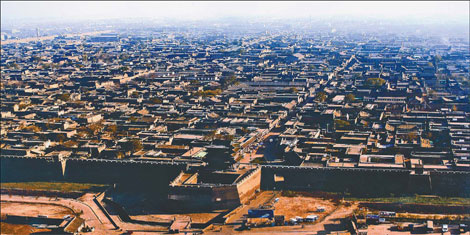
Questions of modernity and history crash into one another in Shanxi province's Pingyao and are - sometimes, literally - pulling the place apart.
The challenges facing Shanxi province's ancient city of Pingyao are perhaps best embodied by the black tarp made lumpy by the jumble of bricks it covers - the remains of a house on West Street that local vendors say collapsed five years ago.
Two adjacent shops elsewhere in the city also tumbled down by themselves on Sept 20, locals say.
These buildings' implosions touch on just one of the questions surrounding Pingyao's competing concerns - issues of restoration and preservation; of commercialization and inhabitation; and of historical lifestyles and modern living standards.
The State Council proclaimed Pingyao old town as a National Historical and Cultural City in 1986. And the 600-year-old birthplace of Shanxi's merchant culture became China's first entire city inscribed on UNESCO's World Heritage List in 1997.
"Pingyao is an exceptionally well preserved example of a traditional Han Chinese city, founded in the 14th century," the UNESCO statement says.
"Its urban fabric is an epitome of the evolution of architectural styles and town planning in imperial China over five centuries. Of special interest are the imposing buildings associated with banking, for which Pingyao was the center for the whole of China in the 19th and early 20th centuries."
The wall came down
That was before the 2004 collapse of a stretch of the city wall. The event highlighted questions surrounding Pingyao's Ming (1368-1644) and Qing (1644-1911) dynastic structures - namely, concerns about preventing natural decay without shedding authenticity through renovations and reconstructions.
The collapse of ancient constructions has been an issue for the past half a century, retired construction worker Fan Laiyuan says.
The 79-year-old, who claims to know "every brick" in the ancient city, says the phenomenon has been part of life since the 1940s.
"It's a combination of age and rainwater seeping into the rammed earth and dissolving the mortar," he says.
"We would tear the damaged structures down to rebuild them. We would ram the earth again to ensure they looked like they had originally and sometimes add new bricks when there weren't enough original ones."
Pingyao County Bureau of Cultural Heritage director Jia Zhongzhao admits several damaged or destroyed buildings have been waiting for or undergoing repair for years.
He says about a dozen regulations on protection have been issued since 1998, and more are on the way.
Fan proclaims a "light touch" philosophy to rebuilding and renovation.
"Fake ancient buildings have no historical value at all," he says.
"There are fewer and fewer unadulterated buildings as time goes on. Call me 'old guard', but I believe we shouldn't change them anymore."
Shanxi traditional architecture scholar Chai Zejun says authenticity in necessary renovations can be better assured by using the original materials and construction methods while replicating the forms as precisely as possible.
"Every time you modify or repair a building, you've changed it," the 76-year-old says.
He says the entire city should be photographed to document its original forms.
Such preservation is particularly important, he believes, for such exchange shops as Rishengchang, which is believed to be China's first draft bank.


Go to Forum >>0 Comment(s)