Baiju from the movies - just for you
- By Mads Schmidt
 0 Comment(s)
 Print
Print E-mail
Radio86, November 18, 2011
E-mail
Radio86, November 18, 2011


|
|
|
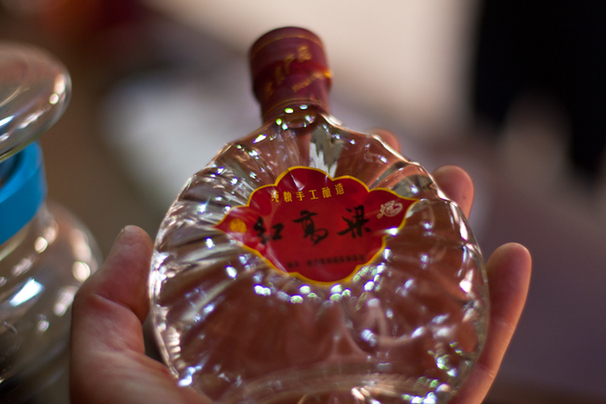
The newly distilled spirit was still warm when it was bottled. [Image: Radio86] |
A combination of exotic Chinese artefacts and fake fibreglass props may leave you somewhat perplexed. But hey, that's China in a nutshell, isn't it?
Perhaps you just want to pour yourself a something to drink - luckily, that fits in here too.
The story plays out in Zhenbeibu China West Film Studio, a 600-year-old fortification that has recently been used as a movie set. Nowadays, the place is a popular tourist destination in Ningxia Hui Autonomous Region.
Red Sorghum Wine
|
|
|
The newly distilled spirit was still warm when it was bottled. [Image: Radio86] |
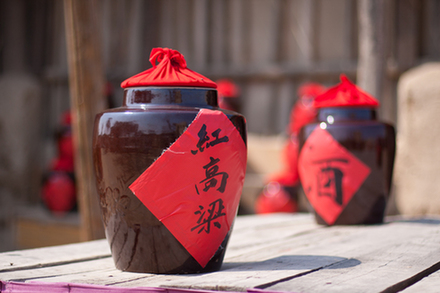
On the set where Zhang Yimou's debut film Red Sorghum was shot, there is a distillery. Better yet, an operative one! Just 12 paces from the distillery, there is a bar. This bar definitely sells spirits that don't get any fresher.
The place to obviously begin is with the making of these spirits. The still is a wooden barrel seated on top of a stone furnace. Below the barrel, a fire burns to evaporate the alcohol from the fermented liquid. Admiring the beauty of the process, Radio86's reporters were able to get the Master Distiller to explain the process.
“First, we must choose the grain and then begin soaking them. After soaking is complete, we must boil the grain until it becomes soft, turning it to a mush. We then steam it until the excess water evaporates. Next, we dry it under the sun,” the Master Distiller explained.
On the floor, an amount of soaked corn is laid out to dry, adding a genuine vibe to the atmosphere. “Once it is dry, we add distiller's yeast and place it into a fermentation pool for about one month. The next step is to return it to the steaming machine. Finally, the rice liqueur appears.”
“This is how it is made,” said the Master Distiller matter-of-factly. It's as simple as that.
After having seen the creation of this clear, pure liquid, the final job, as a reporter, is to taste it. A cupful of this spirit costs five yuan at the conveniently adjacent bar. And yes, it is actually pretty good.
A unique experience is quite cheap
|
|
|
Wine being bottled. Soon it is for sale or maybe even already sold. [Image: Radio86] |
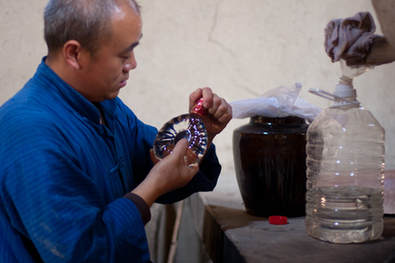
A small bottle of the white wine, in Chinese Bái Jiǔ (白酒), costs 20 RMB, while a nice larger clay bottle is also available, but less practical for travellers.
If you're lucky and/or insistent, you may get a bottle that has just come from the still. You may even witness the distiller bottling, corking, sealing and labelling your bottle. If you ask nicely, he may sign your bottle. So, keep a pen ready.
Now we know how this Chinese spirit is made. A process that is no different from how it is made in other places. Nonetheless, it adds an air of authenticity to a place like the Zhenbeibu film sets. Imagine drinking the same booze as they did in Red Sorghum, back in 1987.
Whether or not this particular batch was made with sorghum is hard to distinguish. To try for yourself, you should travel to Ningxia Hui Autonomous Region in central China. Cheers!


Go to Forum >>0 Comment(s)