Out of this world
 0 Comment(s)
 Print
Print E-mail China Daily, August 9, 2012


|
|
|
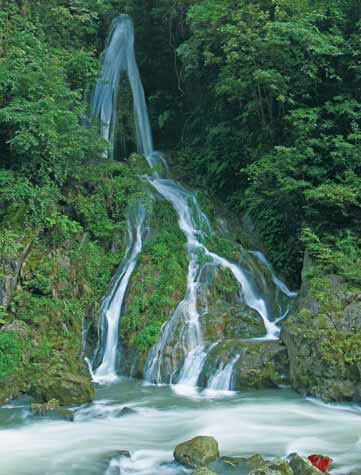
Nanjiang Canyon, where the Qinglong River runs through, has plenty of waterfalls and is an ideal site for rafters. |
Further on from Pingzhai village, about 5 km up Qinglong River, there is an old and huge stone arch bridge named Longevity Bridge. Even after more than two centuries, it still serves people on both banks as their main link.
The bridge is also an ideal starting point to raft down the river, another popular activity during summer. Or, be like the locals - plunge into the clear waters to swim with the young and old.
Not far from the bridge is Matou village, which has a 700-year-old history. It used to be the place where the rulers of the region, an influential tusi, or chieftain, family resided. The village has become a national heritage site.
The thoroughfare of the village is a stone-paved path, where more than 90 ancient buildings are scattered on both sides, with the earliest dating back to the Yuan Dynasty (1271-1368).
Facing the river and flanked by mountains on three sides, these old buildings are mostly traditional courtyard houses bearing wooden structures, with delicate Bouyei carved patterns all over. Layers of gray roofs form a spectacular patchwork.
The Red Army of Communist Party of China (forerunner of the People's Liberation Army) once stayed here, leaving behind dozens of slogans on the walls - more than 20 of these are still recognizable.
Further upstream, there is an even quieter Bouyei community called Shuitou village. At the village gate, villagers in traditional costumes greet us with home-made wine and invite us to join their traditional bamboo dance.
In Shuitou, we learn from locals about the ancestral method of making tofu and the distillation of rice wine.
We are also treated to fresh soybean milk and glutinous rice cake.


Go to Forum >>0 Comment(s)