Resistance against Japan: One museum's take on history
- By William Wang
 0 Comment(s)
 Print
Print E-mail CRI, April 2, 2013


|
|
|
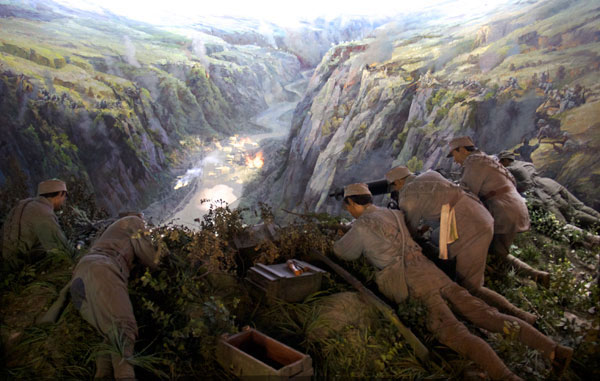
An installation shows soldiers above with projections of trucks and explosions below. [Photo: CRIENGLISH.com/William Wang] |
Lined with sculpted lions, the Marco Polo Bridge in Fengtai district is a wonderfully preserved 12th century bridge that's been pulling curious visitors out to the suburb of Fengtai for 800 years.
But only the history buffs know that this is also the site where the second Sino-Japanese war began. Stemming from military miscommunications on both Japanese and Chinese sides, a minor skirmish went out of control after a Japanese commander found himself unable to abide by the ceasefire ordered by his superiors. To commemorate the history of the war that resulted, the lengthily named Museum of the War of Chinese People's Resistance Against Japanese Aggression (MWCPRAJ), was built just footsteps away from the bridge.
The modern museum is set in a large and austere marble building, divided into a progression of ten separate chapters. Exhibits are presented in a variety of media formats and are explained in Chinese, English and Japanese.
The first few rooms focus on the buildup of tensions and conflict, but frankly lack drama: portraits of politicians, shoe soles and a piece of damaged wood contribute to the displays of artifacts that are all less than gripping. A projection beamed onto a 3D model is the highlight up to this point: Japanese holograms try to flush Chinese holograms out of the tunnels with bombs and water, but the Chinese soldiers and peasants prevail, triumphantly waving the flag in conclusion.
The most riveting and disturbing part of the museum follows: Part IV - The Japanese Army's Extremely Cruel Atrocities. Hard statistics finally make their appearance, along with some emphatic language. "The Japanese army bombed over 900 cities and numerous rural areas, wantonly massacred innocent people, cruelly maltreated and killed captives, enslaved forced laborers, adopted the bacteriological warfare and chemical warfare."
There's no doubt that the Japanese policy to "burn all, kill all, loot all" caused horrific suffering across China, and the proof presented in photos is definitely not for the faint of heart or stomach. Large format black and white photos of bodies piled up or dismembered are all the more shocking when the subjects are women or children. Japan's disturbing use of Chinese "comfort women" is duly noted, as is the damage caused by their tactics of germ warfare, chemical warfare, and opium sales.
All information is factual enough, and the Japanese perspective appears in the final room. In the concluding gallery, the Japanese experience is limited to photos of Japanese solemnly apologizing, graciously accepting China's humanitarian assistance, and photo ops for both countries' leaders.
The Nanjing Massacre Memorial Hall opened two years before the MWCPRAJ, focusing exclusively on the eight years of horrors that transpired in that city. Perhaps due to its broader scope, MWCPRAJ doesn't quite pack the same emotional punch, nor does it feature as much Japanese perspective (which is some of the most interesting material of the Nanjing museum).
One can't help but wonder if a museum like this can stir up more anti-Japanese resentment in a country where not quite everyone has made amends with the past. An employee, Ms. Wu, doesn't think so. "This exhibition is objective and correct," she said earnestly. "We use it for academic research, not to arouse any hostility against Japanese. The aim of this museum is to make people aware of this history."
A man surnamed Zhang was visiting from Baoding, and his own reaction to the museum displays seemed conflicted. "You see, [now] the top leaders have communicated with each other, so these things couldn't happen again," he said, before dwelling on what "these things" consisted of. "Those war criminals were really evil. Cutting up their bodies into bits would be better than just shooting them dead."
He admitted he was upset by the exhibit, and his wife was particularly disturbed by some of the more gruesome photos of murdered children. But his conclusion bore no resentment. "We all cherish peace. There is no need for war."
Another visitor, Yan, was in agreement, though he was skeptical about some ideas presented. He nodded toward the photo of aging Japanese veterans, their heads bowed in a ceremonial apology. "I think those people spoke only on the behalf of only a few Japanese," said Yan. "A lot of Japanese are still hostile to Chinese, and it's the same thing in China. Like for my father's generation. They were persecuted by the Japanese, so it's no wonder they're still furious with them."
In fact, expecting MWCPRAJ to show both sides of the coin is probably unrealistic. However it's particularly useful to help people understand where much of today's animosity toward the Japanese stems from.
For the Tomb Sweeping long weekend just around the corner, groups of people will visit the museum in memory of those who lost their lives in the war against Japan. Activities are held for all memorial holidays, and other special events are held throughout the year. According to vice curator Wu Juan, activities are tailored to students of different ages or adults, such as lectures about hot issues between China and Japan.
The Museum of the War of Chinese People's Resistance Against Japanese Aggression
Cost: free.
How to get there: From Wukesong subway station exit D, take bus #624 to Kangzhandiaosuyuan station. Walk 10 minutes north.



Go to Forum >>0 Comment(s)