Mountainyoga: Retreating to the Fragrant Hills
- by William Wang
 0 Comment(s)
 Print
Print E-mail CRI, May 17, 2013


|
|
|
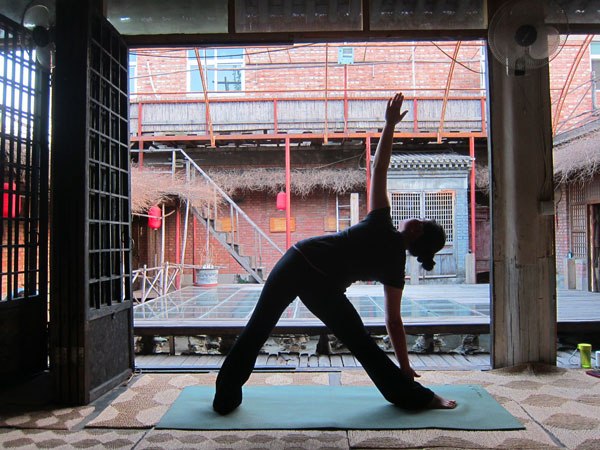
A Mountainyoga instructor demonstrates Trikonasana, the triangle pose. [Photo: CRIENGLISH.com/William Wang] |
Despite having an empty bank account, a Chinese man's daydream about getting a house and swimming pool started him on a pathway which inadvertently ended up with the creation of Mountainyoga, a retreat center which has calmed many a soul (and stretched many a limb).
On a whim, Gyangiri (his yoga name) decided to go out to the countryside where he could rent some cheap land and dig out a pool. While poking around Fragrant Hills, he stumbled across a peaceful courtyard for rent. "I was amazed by the view," he recalls. "It wasn't like it is now, with all these houses and buildings. It was more quiet and had a view overlooking the city."
He rented the place and was in the process of decorating it when a friend mentioned to him that she'd been invited to teach yoga in a cafeteria. This struck Gyangiri as odd. "My first response was 'Why are you doing yoga in a cafeteria? I think yoga is something you should do in the mountains, and I'm decorating a courtyard in Fragrant Hills. Let's do yoga there.'" From that moment on, yoga became the dominant theme of the courtyard, and in 2004, Mountainyoga was born.
Mountainyoga (which is admittedly tricky to find) is a pleasantly rustic spot. The main yoga hall is completely open to the central courtyard which is flooded with beams of sunlight.
Retreat packages range from one to five days, with basic vegetarian food and lodging included. One visitor surnamed Liu commented that the rooms were alright, though chilly at night. Also, running water at the center had become scarce that retreat, which sadly cost her her morning shower. When water’s running, shower times can usually be squeezed in throughout the day as the daily schedule is refreshingly relaxed. It loosely revolves around two yoga sessions, meals and one variable activity (which could be anything from drumming, to calligraphy, to hiking the mountain.).
Mountainyoga is generally staffed by volunteers and even the teachers generally do so unrecompensed. It certainly doesn't mean that the teachers aren't adept, but it doesn't always ensure that they're the most skilled either.
Ao Dingping teaches concise classes of yoga basics. Just by rising up onto the tips of his toes, he wows students with postures of stunning perfection.
But in one class, another local teacher who speaks both Chinese and English failed to give an adequate bilingual instruction to a Chinese visitor, something which would never take place in any of Beijing's posh yoga studios. “It’s not bad,” said Liu. “If they have a foreign teacher teaching foreign students it should be no problem, but if Chinese people go they should also provide proper instruction in Chinese.” A man from Germany thought his first yoga experience at Mountainyoga was fantastic. “I hope to continue,” he affirmed.
In fact, Mountainyoga does invite popular and professional instructors to teach there, but such courses have an additional cost attached, and aren't included in regular retreats.
Also, the daily schedule includes an optional early morning session of karma yoga. Some unfortunate person has to inform gung ho guests that karma yoga will not include downward dog or inversions, but could involve mopping the floor or wiping down windows. Karma yoga equals "selfless service," much to the dismay of guests who aren't yet as selfless as they hope to someday be. "Karma yoga in a traditional ashram," says Gyangiri, "is part of the lifestyle; in the form of volunteer or physical work without any reward."
Gyangiri himself is a big fan of karma yoga. He chuckles as he describes himself as he's done many times before; beginning with the boast that he's not a yoga practitioner. "I don't do yoga because I don't want good health. And I don't want to be in good shape: I don't care. And I don't want to be enlightened. I don't have a spiritual quest by doing yoga. So why would I do yoga?"
He pauses before he brings up yoga-in-action or action with a meditative awareness. "Everything I do is karma yoga." There's no question that, with his long tousles of hair and grizzled beard, he does have the air of a holy man about him.
Fittingly, profit is clearly not his aim in running Mountainyoga. "Up to now, [Mountainyoga's] been running a deficit," he openly admits. "I've been accumulating my personal debts, but things financially are getting better and better because more and more people are coming."
The retreats are popular in part due to their good value. Whereas a single yoga session in the city can cost 150 yuan, packages at Mountainyoga reasonably start at 200 yuan per day.
Gyangiri notes that increasingly more Chinese and foreigners alike are in need of a retreat, a "lifestyle where you can get away from the city, at least for a few days. Where you live a simple lifestyle and get yourself recharged. It's not like going sightseeing. People can take off the masks that they have to wear in the workplace. It's more relaxed and open."
And what about Gyangiri's swimming pool? It was completed, though it already lies now buried underground. "I'm not disappointed," he smiles sincerely. "That idea of having a house and pool with no money brought me to more fun, more meaningful things, such as organizing people doing yoga."



Go to Forum >>0 Comment(s)