Meeting with the ancients
 0 Comment(s)
 Print
Print E-mail Shanghai Daily, May 21, 2013


|
|
|
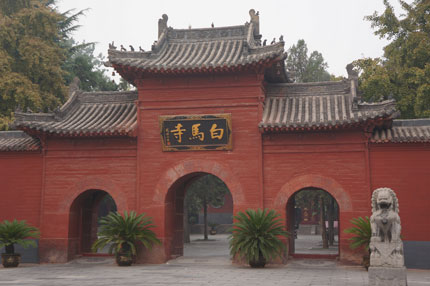
The front gate of Baima Temple, the first Buddhist temple built by the royal family |
To most people, Luoyang in central China's Henan Province is just a transit hub en route to the Shaolin Temple on neighboring Songshan Mountain or a quick stop-off to check out the well-known Longmen Grottoes or the prefecture-level city's spring peony festival.
Luoyang's low-profile is all the more surprising as it was the capital of 13 ancient Chinese dynasties through to AD 937, witnessed the vicissitudes of the country over the millennia and was home to the central plains Heluo Culture (circa 21 century-11 century BC).
Locals often joke that the city is so full of historic sites that you don't even know whose ancient tomb you've just walked over.
But on arrival, first impressions suggested I'd got my hopes a bit too high with visions of a cultural treasure trove. Bulldozers and cranes dominated the landscape, recreating magnificent bygone palaces to satisfy a boom in tourism.
Scenic spots, such as temples, seem alike around the country; squealing tourists following guides reciting the same pat speeches to their parties.
Yet culture is resilient, and Luoyang still has much offer.
In search of art and history
A visit to a museum is a must on a visit to this ancient capital.
You can find an encyclopedic display of central plains Heluo Culture in the new and distinctive-looking Luoyang Museum. Shaped like a ding - an ancient Chinese cooking vessel, the museum sits in the city's Luonan New Area.
Private museums feature specialist collections. One founded by Chinese pottery artist Guo Aihe showcases traditional tricolor glazed art pieces, along with modern pieces.
But to get close to ancient times, visit the Luoyang Museum of Ancient Art. Perched on Mangshan Mountain, the former Luoyang Museum of Ancient Tombs serves as a time tunnel linking past and present.
Mangshan Mountain, or Beimang Mountain, facing the Luohe River, has long been regarded as an ideal burial site, as it retains qi (energy), according to Chinese feng shui.
A poem by Tang Dynasty (AD 618-907) poet Wang Jian recalls the mountain with "no land left," as it was already covered with myriad tombs. The museum has relocated and restored 25 typical ancient tombs, dating back as early as Western Han Dynasty (202 BC-AD 9).
Heat and uproar faded as I descended the stairs to the tombs, seven meters underground. It's cool and damp, but not creepy at all. It's not without its challenges though. I kept knocking my head on the lintels crawling in and out of the tombs.
A highlight in the Western and Eastern Han (AD 25–220) tombs are well-preserved murals inside the chambers, featuring everything from spiritual tales and legends to realistic accounts of rituals and daily life. A 12-meter mural adorns the walls of a tomb of a high-ranking Eastern Han official, depicting a huge marching army of chariots, cavalry and infantry, a vivid depiction of the dramatic life of the tomb's occupant.
Tricolor glazed tomb guardians and funeral objects in the Tang tombs are exquisite and powerful. Their shadows loom on the walls, lending solemnity, and probably also intended to deter grave robbers.
These tombs are silent biographies. Some record the prime of the occupant's life; others reflect solemn blessings and respect for an afterlife.
Buddhist sanctuary
In the east of Luoyang city stands the prosperous Baima Temple. With a history going back 2,000 years, the temple was the first Buddhist temple built by the royal family and is often hailed as the origin of Buddhism in China.
The name Baima - literally meaning white horse - commemorates the animal that carried Buddhist sutras and statues all the way from ancient India in AD 67. To accord with the name, two stone horse statues, which had previously guarded the tomb of a Southern Song Dynasty (1127–1279) general and royal son-in-law, were relocated to the temple gate during renovations in 1935.



Go to Forum >>0 Comment(s)