Tracing the ebbs and flows of history's tide
 0 Comment(s)
 Print
Print E-mail Shanghai Daily, June 17, 2013


|
|
|
Qing'an Guild Hall, where Ningbo's businessmen used to gather to talk business, vividly brings to life the city's trading history. |
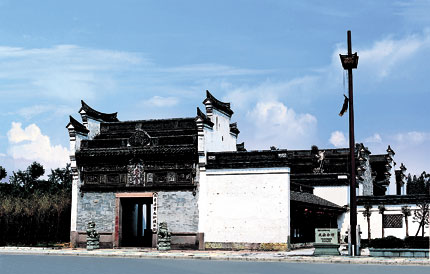
A prosperous port renowned for its long history of trade and industry, Ningbo in eastern China's Zhejiang Province also boasts a feast of cultural riches.
When I heard about my trip to coastal city Ningbo, in eastern China's Zhejiang Province, culture was not the first thing that sprang to mind.
For after all, Ningbo, on the Yangtze River Delta facing the Zhoushan Archipelago in the East China Sea, has long been famed as one of the largest and most important Chinese ports.
Its shipping trade and industrial development over the years have made it one of the richest cities in the country.
But along with this commercial and industrial might, Ningbo has also developed a surprisingly rich culture.
As a National Famous City for Historical Culture, Ningbo is home to 1,530 cultural preservation sites - including 22 sites at national level.
So this time around, my visit to this commercial and industrial powerhouse would focus on a feast of unique culture at an ancient library, a historic guild hall and a spectacular museum.
Tianyige Library
Tianyige Library, the largest private library in China, got its name from "I Ching," or the "Book of Changes."
According to this classic book of yin and yang, which may date back to the second millennium BC, a combination of "tian" (sky) and "yi" (one) gives birth to water.
This magical name has protected the library and its books from fire for more than 400 years.
Before the trip, I'd heard a lot about Tianyige, such as it's the oldest private library in China and has more than 300,000 historic books.
However, the building itself was quite different from what I'd imagined - a modest two-story wooden structure.
From its appearance, it could be taken for just the ordinary residence of a big family.
This humble, dark library was built by Fan Qin in 1566, a secretary of defense during the Ming Dynasty (1368-1644).
Fan worked as a government official in many provinces, including Shaanxi, Hunan and Fujian.
As a book lover, on his travels Fan collected more than 70,000 volumes from all over China and built Tianyige in his hometown Yin County, today's Ningbo City, to house them.
His collection covered a wide range of texts, including local chronicles, records of imperial examinations, political documents and anthologies.
Most are block-printed and manuscript editions from the Ming Dynasty.
Private libraries have been a tradition among Chinese scholars since Han Dynasty (206BC-220AD), especially government officials.
Thanks to the prosperous commercial development, Jiangsu and Zhejiang provinces became the center of these private libraries during the Ming and Qing (1644-1911) dynasties.
More than 60 percent of private libraries in China were found in these two provinces.
These created the foundations for preserving cultural heritage, as they collectively had more books than state-owned institutions.
However, many were short-lived.
Some fell prey to natural causes such as fire, damage by insects and humidity.
Others ended up in the stewardship of founders' descendants who might not share the same enthusiasm or were financially challenged.
In fact, very few private libraries were able to pass down more than three generations.
That's why Tianyige is so special in Chinese history - it has survived almost 450 years and has been passed down through 13 generations of Fan's family.
Fan Qin established strict rules to protect the valuable books in his library.
A small lake was built in front, providing a ready source of water should the building catch fire.
Flames and alcohol were prohibited, while insect-repellent leaves and grasses were put on bookshelves.
In another measure, Fan's descendants were entrusted with different keys to separate locks at Tianyige.



Go to Forum >>0 Comment(s)